Foreword: 2024 Annual Report on the Death Penalty in Iran
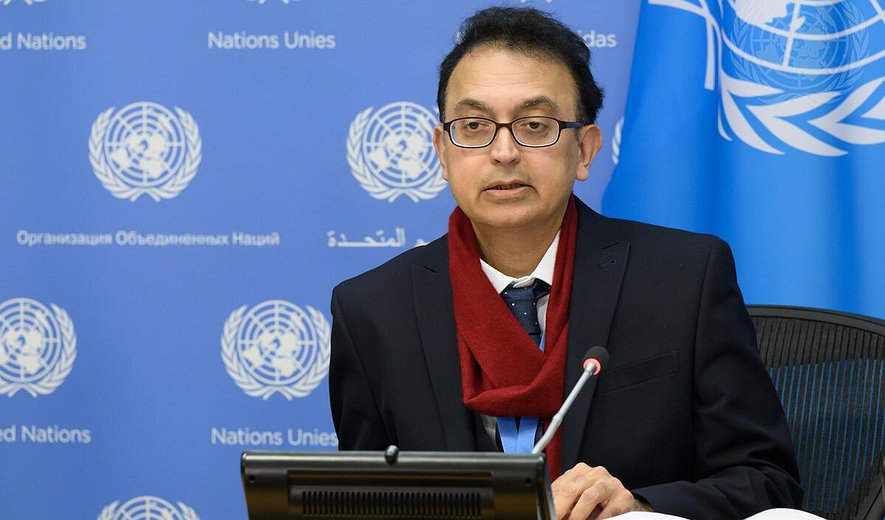
Every year, leading personalities, lawyers and human rights defenders write the foreword to the Annual Report on the Death Penalty in Iran. For the 2024 report, we are honoured to have Professor Javaid Rehman, the former United Nations Special Rapporteur on the situation of human rights in the Islamic Republic of Iran, pen the foreword.
I am greatly honoured to have served for a full and maximum term as the United Nations Special Rapporteur on the situation of human rights in the Islamic Republic of Iran between July 2018 – July 2024.
Throughout my mandate, I expressed grave concerns at the arbitrary deprivation of life and also expressed alarm and shock at the summary, arbitrary, and extra-judicial executions of tens of thousands of political opponents of the regime ever since the inception of the Islamic Republic of Iran in 1979. In my final detailed findings, I documented the summary, arbitrary and extra-judicial executions of thousands of arbitrarily imprisoned political opponents, amounting to the crimes against humanity of murder and extermination, as well as genocide between 1979–1988.[1] These executions included those of women some of them reportedly raped before their executions, and a very large number of children. In my findings I highlighted the tragedy of the 1988 Massacre, which resulted in the mass murder, summary, arbitrary and extra-judicial executions as well as enforced disappearances of thousands of political prisoners between July–September 1988. In light of the evidence presented to me, I take the view that “atrocity crimes” of crimes against humanity and genocide were committed by the Iranian regime against members of the political opposition in 1988.[2]
The targeting of political prisoners and their arbitrary deprivation of life has continued: six men are at a serious risk of execution after extremely unfair trials. As reported by Amnesty International “In October 2024, Branch 26 of the Revolutionary Court of Tehran convicted them of ‘‘armed rebellion against the state’’(baghy) and sentenced them to death following a grossly unfair trial marred by allegations of torture and other ill-treatment to extract forced ‘confessions.’”[3]
The practice of executions goes beyond those convicted of political and national security crimes. In fact, there are at least 80 offences which carry the death penalty in the Islamic Republic of Iran ranging from qisas (retribution in kind) to “offences” such as adultery, homosexuality, apostasy and blasphemy, drug related offences as well as the various national security offences. By not restricting death penalty to the “most serious crimes”, Iranian authorities violate the right to life as provided in Article 6(2) of the International Covenant on Civil and Political Rights (ICCPR)[4] to which the Islamic Republic of Iran is a state party. According to the Human Rights Committee – which oversees the implementation of the ICCPR – “the term ‘the most serious crimes’ must be read restrictively and appertain only to crimes of extreme gravity, involving intentional killing. Crimes not resulting directly and intentionally in death, such as attempted murder, corruption and other economic and political crimes, armed robbery, piracy, abduction, drug and sexual offences, although serious in nature, can never serve as the basis, within the framework of article 6, for the imposition of the death penalty”. [5]
As one of the highest executioners in the world, the Islamic Republic of Iran executes individuals in violation of international human rights law, including by violating the right of the accused to a fair trial; through the implementation of the sentence in a manner that constitutes torture, cruel, inhuman and degrading treatment, and by expressly targeting arbitrarily and disproportionately Iran’s ethnic, linguistic and religious minorities. During my mandate as the Special Rapporteur on the human rights situation in the Islamic Republic of Iran, I took the view that almost all of the executions in Iran represented arbitrary deprivation of the right to life and in complete violation of international law.
The available figures for the executions that took place in 2024 are extremely shocking and alarming: it is reported that last year, at least 975 persons were executed, compared to 834 executions in 2023.[6] It is also enormously worrying to note that in 2024, over 50% of those executed were reportedly for drug-related offences.[7] The Iranian regime is reportedly the highest executioner of women in the world and – completely contrary to the Country’s own obligations within international law – child offenders are executed every year. At least one child was executed in 2024.[8] The discriminatory and disproportionate nature of executions was tragically reflected in the executions of Baluch and Kurdish minorities.
The death penalty is weaponised and instrumentalised against people who are vulnerable and weak, typically from marginalised communities. For pragmatists and human rights defenders, the dangers of arbitrariness, the unfairness of implementation in the criminal justice system and the overall ineffectiveness of the death penalty far outweigh any suggested justifications in support of this punishment. The imposition of the death penalty neither serves justice, nor – as overwhelming evidence establishes – does it make societies safer.
The death penalty equates to violence perpetrated by the State: retaining the death penalty is a violation of human rights and human dignity. This sentiment is also echoed by the Human Rights Committee in its General Comment 36, where the Committee notes that “the death penalty cannot be reconciled with full respect for the right to life, and abolition of the death penalty is both desirable and necessary for the enhancement of human dignity and progressive development of human rights”.[9]
In the context of the Islamic Republic of Iran, I greatly value and salute the bravery and courage of political prisoners who in January 2024 staged a protest which transformed into a weekly hunger strike known as “Black Tuesdays” and “No Death Penalty Tuesdays”. These mass hunger strikes and statements condemning the death penalty and executions have now spread to 35 prisons across Iran.
In my capacity as the Special Rapporteur (2018–2024), I provided at least 35 recommendations to the Iranian authorities calling for the death penalty to be abolished and laws that are incompatible with the right to life repealed.[10] As the former Special Rapporteur, I once again recommend an immediate abolition of the death penalty for all offences and in all circumstances.
[1] UN Special Rapporteur on the situation of human rights in the Islamic Republic of Iran, Javaid Rehman, “Atrocity Crimes” and grave violations of human rights committed by the Islamic Republic of Iran (1981–1982 and 1988): Detailed findings, op. cit.
[2] Ibid.
[3] Amnesty International: Iran: Six Men at Risk of Execution After Grossly Unfair Trial, 23 January 2025, https://www.amnesty.org/en/documents/mde13/8965/2025/en/ - Amnesty International (last accessed 25 January 2025).
[4] New York, 16 December 1966 United Nations, 999 U.N.T.S. 171; 6 I.L.M. (1967) 368.
[5] UN Human Rights Committee, General Comment No. 36, Article 6: right to life, 3 September 2019, CCPR/C/GC/36, para. 35.
[6] IHRNGO and ECPM, Annual Report on the Death Penalty in Iran, 2024, https://iranhr.net/en/reports/42/; UN Special Rapporteur on the situation of human rights in the Islamic Republic of Iran, Javaid Rehman, Situation of human rights in the Islamic Republic of Iran, 9 February 2024, A/HRC/55/62, https://documents.un.org/doc/undoc/gen/g24/012/59/pdf/g2401259.pdf, para. 8.
[7] IHRNGO and ECPM, Annual Report on the Death Penalty in Iran, 2024, https://iranhr.net/en/reports/42/
[8] Ibid.
[9] UN Human Rights Committee, General Comment No. 36, op. cit., para. 50.
[10] UN Human Rights Council, Situation of human rights in the Islamic Republic of Iran, 2024, op. cit., para. 59.
More from @ihrights
IHRNGO is building a strong civil society, through empowerment of the citizens, promoting and defending the human rights.
Latest Cartoon