500+ Drug Defendants Awaiting Gallows in Ghezelhesar Prison
Iran Human Rights (IHRNGO); September 28, 2025: More than 500 death row drug defendants are awaiting the gallows in just four halls of a single unit (Unit 2, Halls 14, 15, 16 and 17) at Ghezelhesar Prison. These prisoners’ death sentences are all at the implementation stage.
Iran Human Rights has learned that the judiciary has issued an order for the expedited execution of defendants whose death sentences are awaiting implementation, raising concern that the number of executions may rise even further in the coming days and weeks.
These death row prisoners represent only a fraction of those on death row for drug-related offences. Due to the lack of transparency in the Islamic Republic’s judiciary, the total number of death row prisoners in Iran remains unknown.
More than 1000 people have been executed in Iran in less than nine months in 2025, around half for drug-related charges. Iran Human Rights once again stresses that the authorities use the death penalty as a tool of fear and political repression to contain crises arising from state corruption. It has called on the international community to respond urgently and urged the UN Human Rights Council’s Independent International Fact-Finding Mission on Iran to investigate the current wave of executions as crimes against humanity.
IHRNGO Director Mahmood Amiry-Moghaddam stated: “The disturbing reports that 500 prisoners are at imminent risk of execution in just one prison unit in Iran show that the authorities are preparing a far larger execution wave than we have seen so far. The international community has a duty to act immediately to prevent a mass killing of prisoners who have not even been granted fair trials. The UNODC which cooperates with Iran on combating drug-trafficking, must break its silence on the mass killings being carried out in the name of war on drugs.”
Following the closure of Rajai Shahr Prison (formerly Gohardasht Prison) in 2023, Ghezelhesar Prison has emerged as the new epicentre of executions in Iran. With the majority of Rajai Shahr prisoners transferred to Ghezelhesar, it is now one of the largest prisons and the execution capital of Iran. There are no exact statistics on the number of death row prisoners held at the prison. However, according to IHRNGO data, at least 169 executions, or 17% of all recorded executions in 2024, were carried out at the prison. Between January-23 September 2025, at least 126 executions were carried out at the prison, 56 of which were for drug-related charges. Drug-related charges lead to the most number of executions and are carried out in prisons across Iran, yet the transparency is the lowest of any charges. In 2025, none of the drug-related executions verified and reported by IHRNGO have been reported by official sources.
Official data on the number of death row prisoners do not exist, IHRNGO previously reported at least 120 drug death row prisoners in Yazd Central Prison (November 2021), at least 45 death row prisoners in Kashan Prison (9 November 2023), at least 90 in Zanjan Central Prison (16 February 2025), at least 50 in Shiraz’s Pirbanu Prison (2 May 2024) and 70 murder death row prisoners in Isfahan Central Prison (1 November 2024).
Drug-related Executions in Recent Years
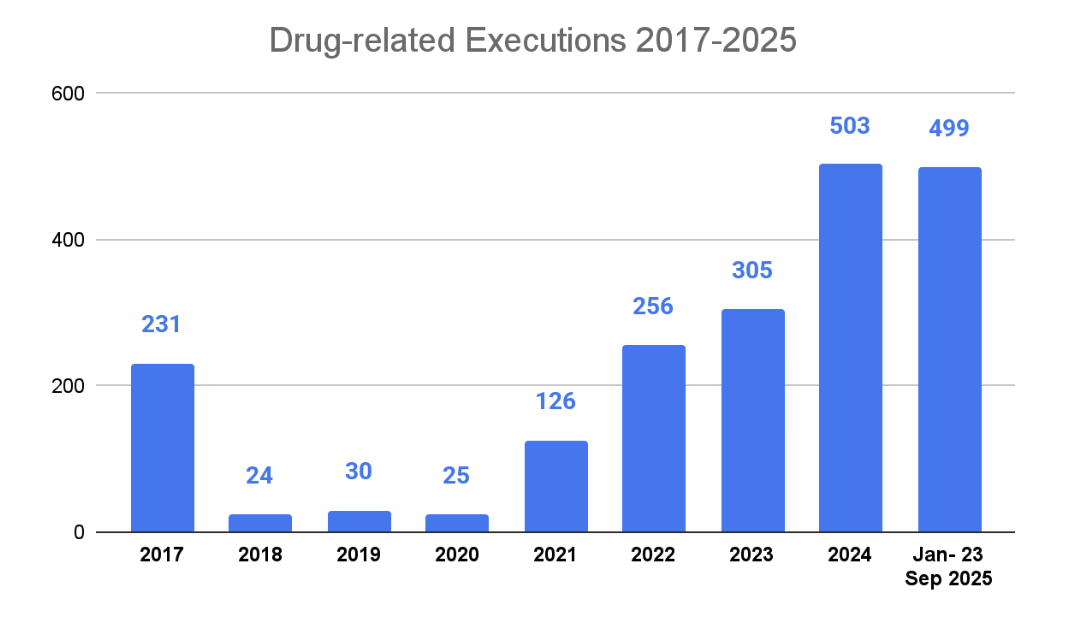
The 2017 Amendment to the Anti-Narcotics Laws created hope that it would eventually lead to a complete halt in drug related executions. And while it did lead to a decline in male drug executions and a complete drop in female executions until 2021, the outcome was not guaranteed. Since 2021, the 2017 Amendment has been reversed in practice, with drug-related executions rising nineteen-fold from an average of 26 per year between 2018-2020 to at least 503 in 2024. Between 1 January-23 September 2025, at least 499 people were hanged for drug-related offences in all 31 provinces of Iran.
Those executed on drug-related charges are predominantly from deprived and marginalised communities and rank amongst the most voiceless victims of the death penalty in Iran. Like security-related charges, drug offences fall under the jurisdiction of the Revolutionary Courts, which systematically violate defendants’ rights to a fair trial and due process.
More from @ihrights
IHRNGO is building a strong civil society, through empowerment of the citizens, promoting and defending the human rights.
Latest Cartoon