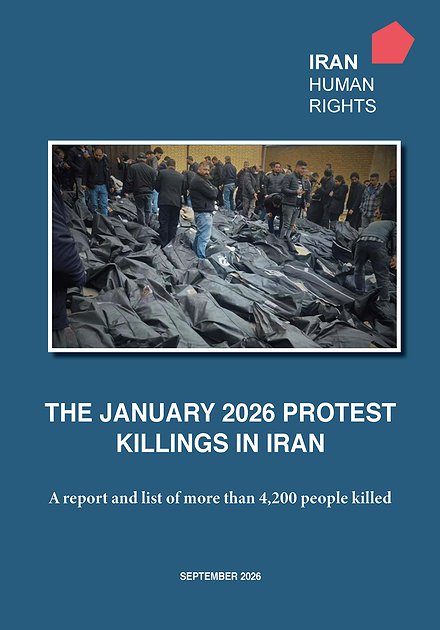
Executions for Murder Charges in 2025
This is an excerpt from the 2025 Annual Report on the Death Penalty in Iran.
As murder is specifically punished under qisas laws, the IPC does not explicitly state that convicted murderers are subject to the death penalty but rather to qisas, or “retribution-in-kind”. In cases of murder, the law effectively puts the responsibility for executions in the hands of the victim’s family or next of kin. Qisas death sentences are also imposed on juvenile offenders as, according to Sharia, the age of criminal responsibility for girls is 9 and for boys 15 lunar years. Furthermore, the death penalty is generally subject to discriminatory application based on gender, ethnicity and religion.[1]
In addition to the inequality of citizens before the law, there are countless reports of violations of due process in qisas cases. Examples include the use of torture to extract confessions, summary trials without sufficient time to conduct independent investigation of the evidence and ineffective counsel.
Facts and figures about qisas executions in 2025
- At least 747 executions were carried out for murder charges based on qisas laws compared to 419 in 2024, 282 in 2023, 288 in 2022 and 183 in 2021
- This is the highest number of annual qisas executions since 2010
- 52 (under 7%) of the qisas executions were announced by official sources
- 32 of those executed for murder charges were women (67% of all women executions)
- 110 qisas executions were carried out in Alborz prisons
Executed for murder charges in 2025
The 747 qisas executions in 2025 include a variety of cases. In all cases, defendants were denied their rights to due process and a fair trial. More information on the execution of women can be found in “Execution Categories."
Babak Hajipour
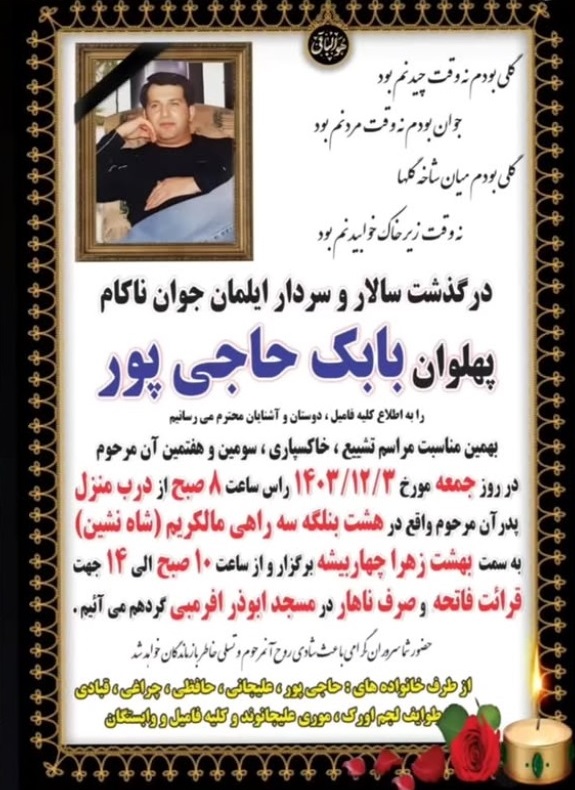
Babak Hajipour was a 49-year-old man from Masjed Soleiman. He was arrested for murder 31 years ago but exonerated after spending four years behind bars. However, he was retried in absentia and sentenced to qisas (retribution-in-kind) for murder and rearrested in 2015. After spending another ten years on death row, Babak was ultimately hanged in Ahvaz Sepidar Prison on 20 February 2025.[2]
Ali Dehani
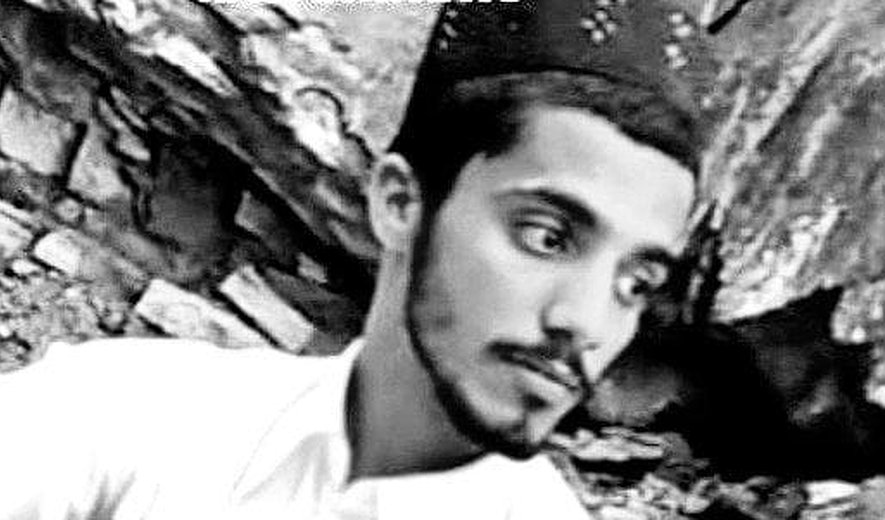 Ali Dehani was a Baluch conscript soldier from the village of Gend in the Sib and Soran county. He was serving at the Kaskin outpost in Bampur county during the “Woman, Life, Freedom” nationwide protests in 2022. According to informed IHRNGO sources, “On 6 November 2022, a week after Bloody Friday,[3] some policemen were mocking and insulting Molana Abdolhamid (the Zahedan Friday prayer Imam). Ali got into an altercation with them in defence of Molana Abdolhamid, during which four people were killed.” Ali was sentenced to qisas and hanged in Zahedan Central Prison on 14 April 2025.[4]
Shamseddin Fazli
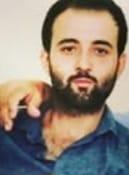 Shamseddin Fazli was a 27-year-old man who was at the wrong place at the wrong time. Three years prior, he was on Meraj Boulevard in Tabriz when a fight broke out in front of a greengrocer’s stand. According to informed IHRNGO sources, “ He was trying to separate the two people fighting when one of them was killed by stabbing. Everyone else ran away but Shamseddin refused to leave the injured man. That’s why he was the one arrested when police arrived on the scene. He took an oath twice in court that he was innocent but the witnesses testified that he was the one that had stabbed the victim.” Shamseddin was sentenced to qisas and hanged in Tabriz Central Prison on 9 April 2025.[5]
Ahmad Hashami
Ahmad Hashami, a 28-year-old man from Miandoab, was arrested for murdering his brother-in-law during a fight in Chaharborj in 2023. He was sentenced to qisas and hanged in Miandoab Prison on 17 September 2025. After his execution, Ahmad’s brother went to the victim’s family supermarket and killed two of his relatives in revenge for the execution.[6]
Qisas executions since 2010
According to data gathered by IHRNGO, at least 3,597 qisas executions were carried out between 2010 and 2025. The diagram below shows the trend of qisas executions during this period.
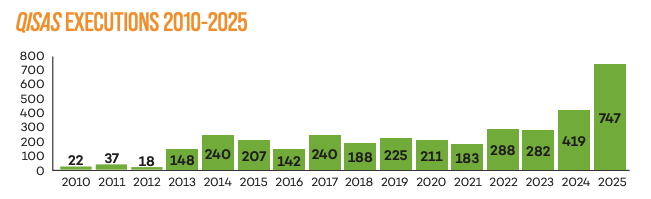
The number of qisas executions, which was relatively low between 2010 and 2012, increased dramatically in 2013 coinciding with growing international criticism of Iran’s drug-related executions. In 2025, at least 747 people were subjected to qisas executions, the highest recorded number of annual qisas executions in at least 16 years.
Blood money (diya) or forgiveness instead of the death penalty in qisas cases
According to the IPC, murder is punished by qisas, where the victim’s next of kin can demand execution as retribution. But they can also demand diya (blood money) instead of retribution or can simply grant forgiveness. The Head of Judiciary sets an annual indicative amount for diya based on inflation and other considerations, but the victim’s family can choose their own amount. They can demand a lower or higher amount than the judiciary’s indicative number but crucially, no upper limit is set. The diya indicative amounts, which are determined every March, were set at 1.2 billion tomans (€18,000) for a Muslim man and 600 million tomans (€9,000) for a Muslim woman in March 2025, a 33% increase compared to the previous year.[7] The amount set by families is usually higher than the indicative amount and even the indicative amount is higher than what most families can afford. Davoud Alinejad[8] and Ali Shokat[9] were amongst those executed in 2025 because they could not afford to pay the blood money[1] .
In her March 2025 report, Mai Sato, the UN Special Rapporteur on the situation of human rights in Iran, called on the government “To review the abolition of diya, in line with article 6 (2) of the Covenant and, pending abolition, set an upper limit for diya.”[10]
IHRNGO has collected forgiveness reports since 2015. For the first time in eleven years, documented qisas cases outnumbered those of families of murder victims choosing forgiveness.
For the sake of simplicity, the term forgiveness is used in the following section, regardless of whether there was a demand for diya.
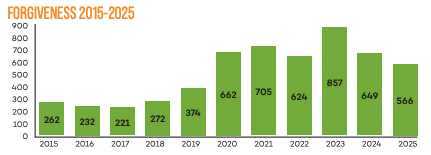
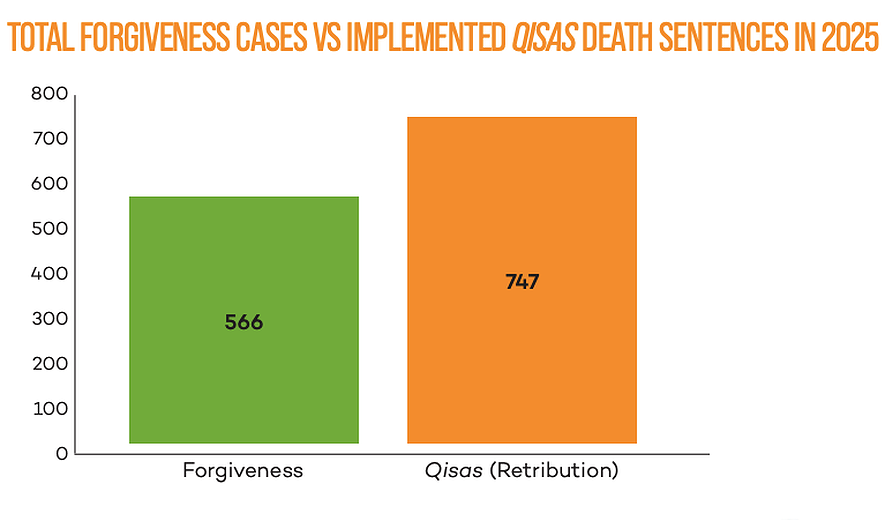
As with executions, not all forgiveness cases are reported by the Iranian media. Based on reports by the Iranian media and, to a lesser extent, through its own network inside Iran, IHRNGO identified 566 forgiveness cases in 2025, compared to 649 cases in 2024, 857 cases in 2023, 624 cases in 2022 and 705 cases in 2021.
In 2025, for the first time since IHRNGO began documenting forgiveness cases, qisas executions outnumber forgiveness cases. The actual numbers for both forgiveness and qisas death sentences are believed to be higher. IHRNGO estimates that the number of forgiveness cases might be several times higher than the numbers presented in this report. The decline in the 2025 numbers may be partially due to underreporting in the shadow of the war and the declining economic conditions.
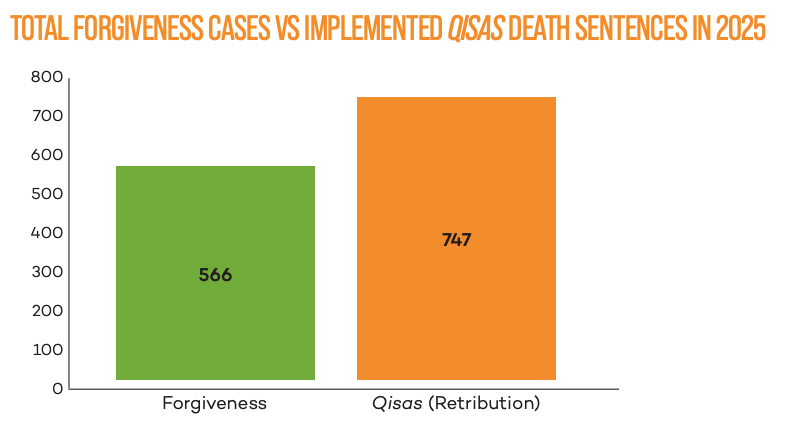
A comparison of the number of implemented qisas death sentences and forgiveness cases in 2025.
Qisas (retribution) and forgiveness: monthly breakdown
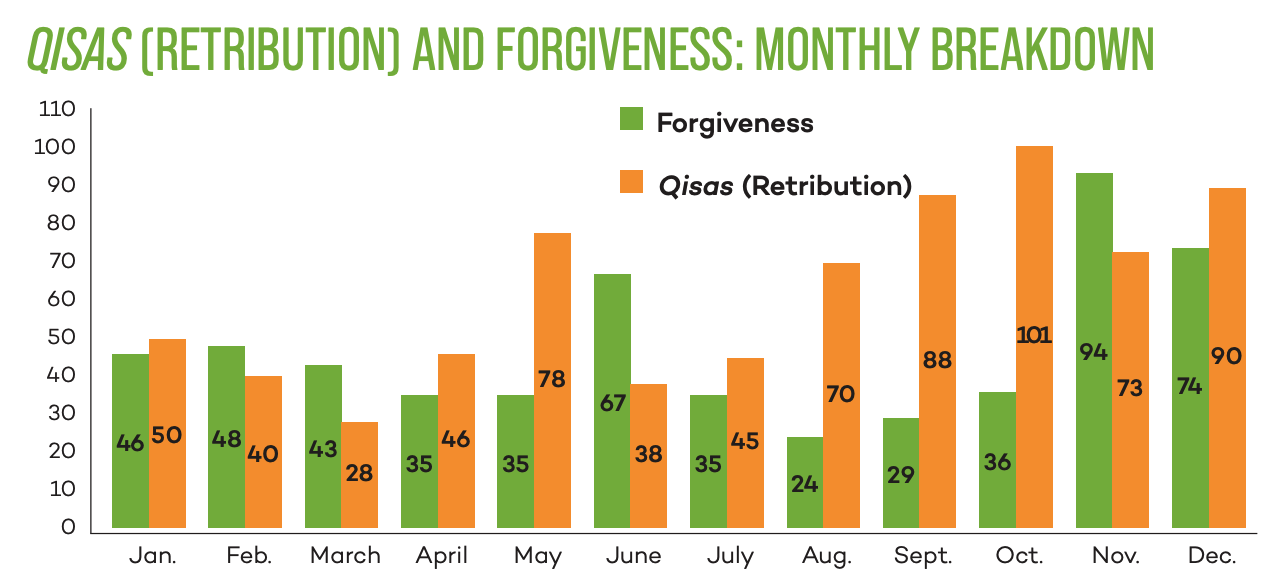
The diagram above shows the monthly breakdown of implemented qisas death sentences compared to forgiveness cases. Forgiveness cases outnumber those of qisas executions in 8 months of the year.
Qisas and forgiveness: geographic distribution
In 2025, IHRNGO recorded forgiveness and qisas cases in all provinces in Iran. While qisas executions outnumbered forgiveness cases overall, forgiveness cases outnumbered qisas cases in seven provinces.
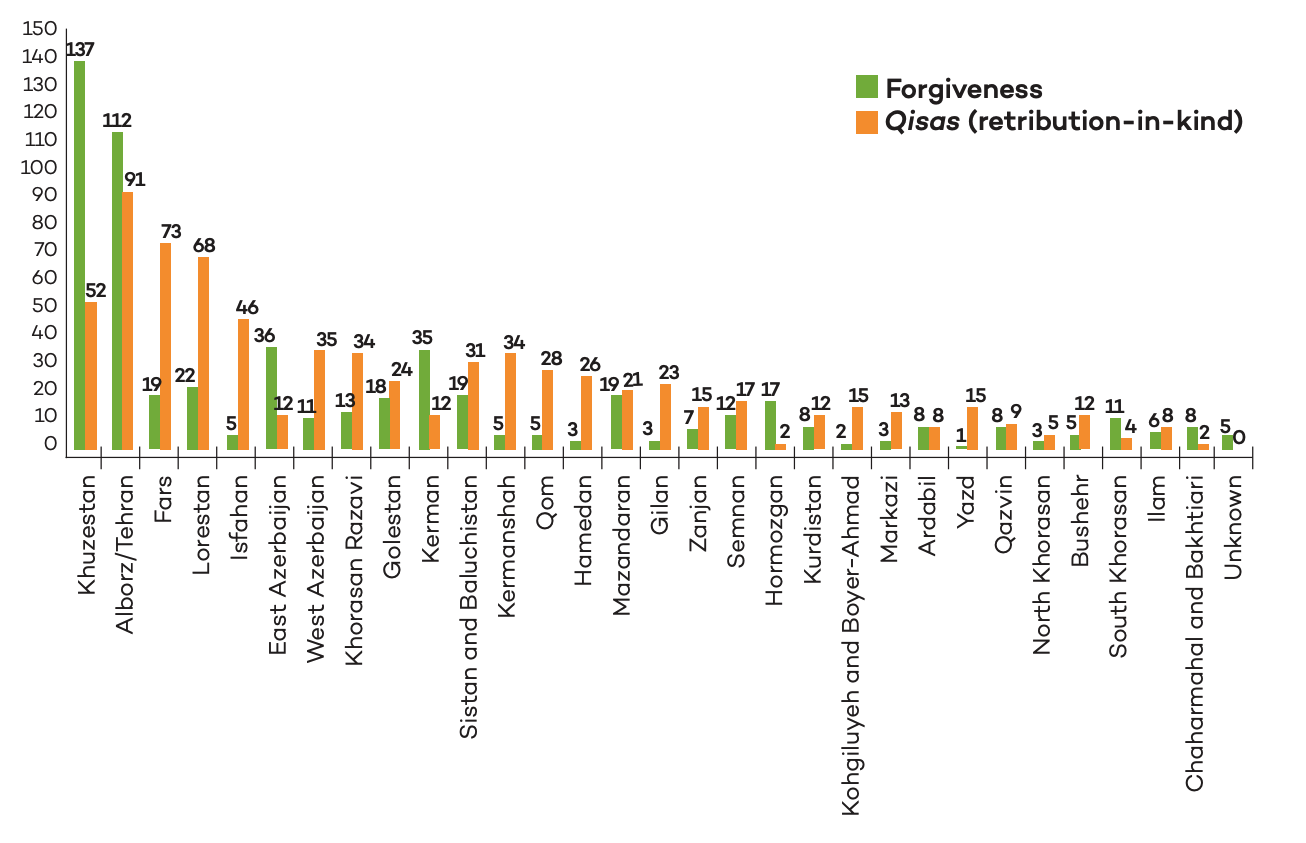
The number of qisas executions were higher than forgiveness cases in seven provinces, while the forgiveness numbers were higher than qisas executions in the remaining provinces.
[1] IHRNGO and ECPM, Annual Report on the Death Penalty in Iran, 2013, https://www.ecpm.org/app/uploads/2022/08/Rapport-Iran-2013.pdf, p. 11.
[2] https://iranhr.net/en/articles/7369/
[3] https://iranhr.net/en/articles/6212/
[4] https://iranhr.net/en/articles/7470/
[5] https://iranhr.net/en/articles/7482/
[6] https://iranhr.net/en/articles/8055/
[7] https://www.mizanonline.ir/fa/news/4764775/نرخ-دیه-سال-۱۴%DB%B0۳-اعلام-شد
[8] https://iranhr.net/en/articles/7673/
[9] https://iranhr.net/en/articles/7848/
[10] https://docs.un.org/en/A/HRC/58/62
[1]Add a reference to the UPR submission
More from @ihrights
IHRNGO is building a strong civil society, through empowerment of the citizens, promoting and defending the human rights.
Latest Cartoon
Latest Report