Secret and Unannounced Executions in 2025
This is an excerpt from the 2025 Annual Report on the Death Penalty in Iran.
More than 93% of all executions recorded by IHRNGO in 2025, i.e. 1,526 executions, were not announced by the authorities. Some of the executions were carried out secretly, without the family or the lawyer being informed, and some were simply not announced by the official media. This is despite the fact that, according to the Islamic Republic’s own laws, the defendant’s representative must be notified of the planned execution. The actual number of executions is certainly much higher. This lack of transparency has been increasing in recent years. In 2025, less than 7% of the recorded executions were officially reported, compared to 10% in 2024, 15% in 2023, 12% in 2022, 16.5% in 2021 and an average of 33% in 2018-2020.
Facts about secret and unannounced executions in 2025
- At least 1,526 executions (over 93% of the total) were not announced by official Iranian sources
- Only 3 (less than 0.4%) of the 795 drug-related executions were announced by official sources
- Drug-related offences accounted for 52% of unannounced executions
- Murder charges accounted for 45.6% of unannounced executions
- Tehran/Alborz province had the highest number (165) of unannounced executions, followed by Isfahan (139) and Fars (136)
In her March 2025 report, Mai Sato, the Special Rapporteur on the situation of human rights in Iran stated: “To meet [their obligations of transparency and accountability], the Islamic Republic of Iran should enable the reporting of all capital cases, make individual judgments publicly available, regularly release statistics of death sentences handed down at trial or on appeal and provide execution figures specifying the offence and accompanied by demographic information.”[1]
Documentation of unannounced executions
Only unofficial reports with sufficient information have been included in this report. IHRNGO’s network inside the country receives information about many executions which are not announced by domestic media or officials. Confirming these reports is a challenging task, as the media is either directly controlled or under strong scrutiny by the authorities. Reporting human rights violations to human rights organisations is also regarded as a crime, and those involved face criminal prosecution. Notwithstanding, every year IHRNGO manages to confirm several hundred cases of executions that are not announced by the authorities. In many of these cases, information on executions is verified by two or more independent sources. In some cases, IHRNGO receives photographs that can document the execution. In many cases, photographs with information about the executed person are sent to IHRNGO.
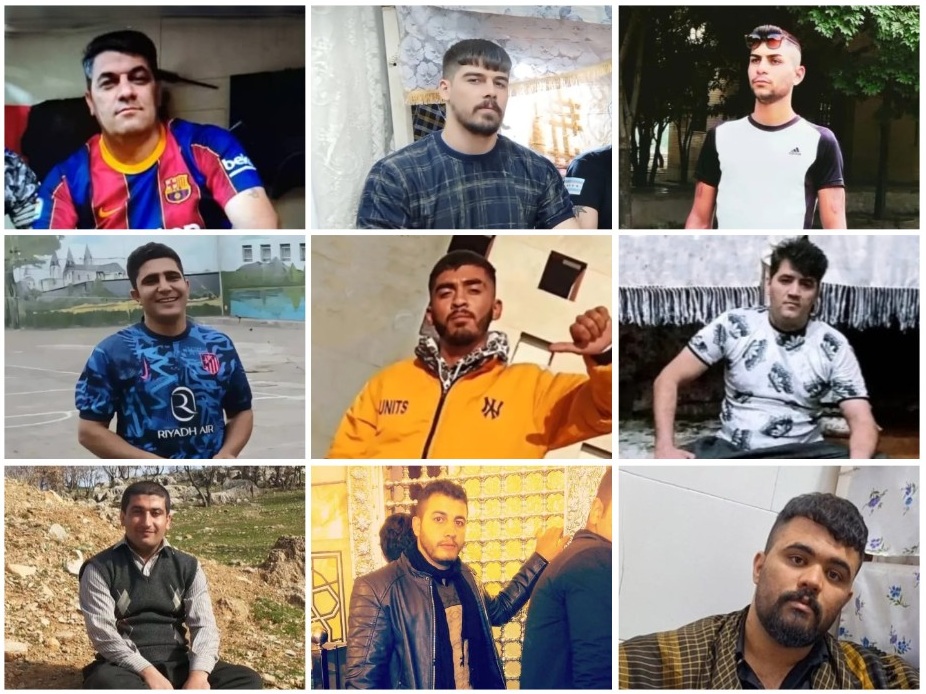
Photographs of some of the people whose executions were not announced by official sources, but whose execution was documented by IHRNGO in 2025
Death or funeral notices are also used as documentation to support reports of unannounced executions received by IHRNGO. 553 executions reported to IHRNGO were not included in the 2025 figures due to lack of sufficient documentation or confirmation by two independent sources.
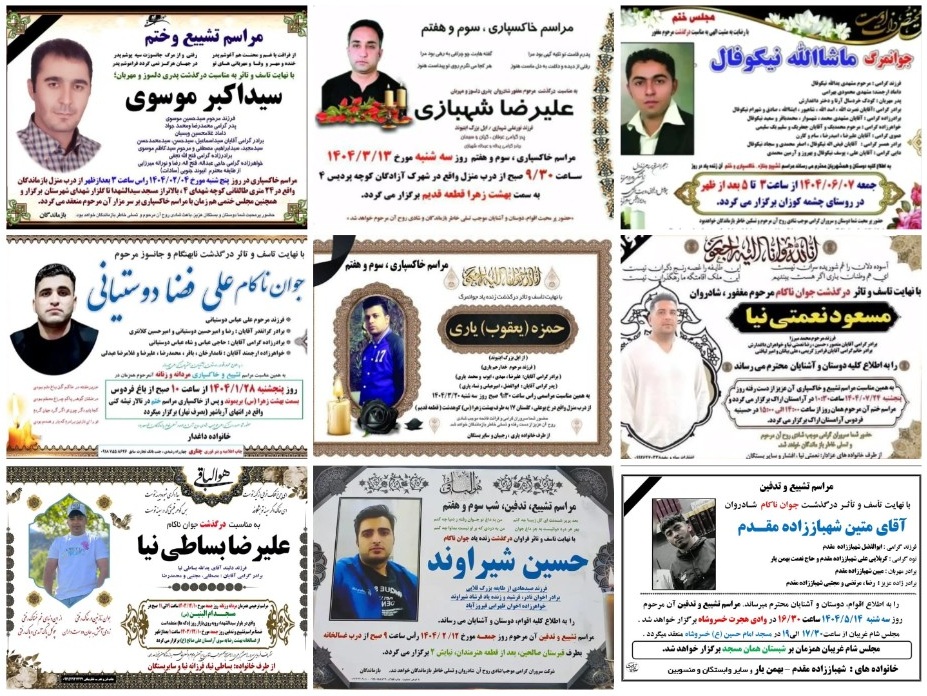
Death notices showing some of the people whose executions were not announced by official sources but were documented by IHRNGO.
Geographic distribution of announced and unannounced/secret executions
In 2025, the highest number of unannounced executions took place in Ghezelhesar Prison, Isfahan Central Prison and Shiraz Central Prison.[2]
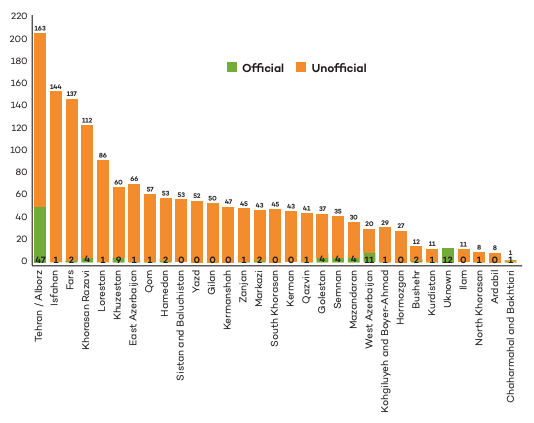
The diagram above shows the geographical distribution of the official (green) and unofficial/unannounced (orange) executions in Iran. The prisons in the provinces of Tehran/Alborz, Isfahan and Fars had the highest number of recorded executions. This was followed by Khorasan Razavi, Lorestan and Khuzestan. The exact location of twelve executions, announced officially, were not disclosed.
[1] https://docs.un.org/en/A/HRC/58/62
[2] Further details are provided in the following section.
More from @ihrights
IHRNGO is building a strong civil society, through empowerment of the citizens, promoting and defending the human rights.
Latest Cartoon
Latest Report