Ethnic Minorities Executed in 2025
This is an excerpt from the 2025 Annual Report on the Death Penalty in Iran.
As the previous annual reports have demonstrated, ethnic minorities in Iran are overrepresented in death penalty statistics. According to the present report, 163 people were executed in the 4 ethnic provinces of West Azerbaijan, East Azerbaijan, Sistan and Baluchistan, and Kurdistan in 2025, accounting for 10% of all recorded executions in 2025. This number was 145 in 2024 (15%), 150 in 2023 (18%), and 130 in 2022 (22%). The proportion of executions in ethnic regions compared to the total number of executions was lower in 2025 than in previous years. This appears to be due to the most dramatic increase in executions being recorded in central provinces such as Isfahan and Fars, possibly reflecting the Islamic Republic’s growing fear of protests in central parts of the country and in large cities.
As the execution of ethnic minorities are not implemented exclusively in their home provinces, it is difficult to identify the exact number of executions of each ethnic minority group. In 2025, execution of Baluch and Kurdish prisoners were carried out in 15 and 17 different provinces, respectively. Furthermore, information about those executed does not always include their ethnicity. Executions of Baluch prisoners are in many cases carried out in prisons outside the Baluchistan region.
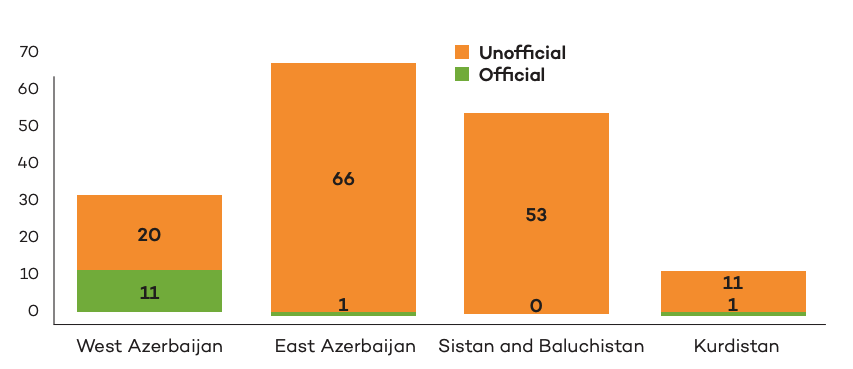
In 2025, more than 92% of the executions recorded by IHRNGO in East and West Azerbaijan, Kurdistan and Sistan and Baluchistan were not announced by the authorities. None of the executions in Baluchestan were announced by official media
Furthermore, the absolute majority of those executed for their political affiliation belong to ethnic groups, the Kurdish in particular. An overview of IHRNGO reports between 2010-2025 shows that at least 182 people were executed for affiliation to banned political and armed groups. Of those, 87 (48%) were Kurdish, 49 (27%) were Baluch and 30 (16%) were Arab, with a majority of them being Sunni Muslims.
There are several possible reasons for the overrepresentation of ethnic groups in execution figures. One explanation might be that the authorities use more violence to create fear due to higher opposition amongst the population in those regions. During the nationwide protests following Jina (Mahsa) Amini’s state killing, Kurdish regions and Baluchistan were the areas with the longest-lasting protests, and almost half of all protesters killed on the streets were from Baluchistan, Kurdistan and other Kurdish towns in other provinces. The authorities’ targeted propaganda labelling its critics in the ethnic regions as separatists, as well as the presence of armed groups in those regions makes it easier for authorities to justify death sentences under the pretext of fighting terrorism and separatism. All this has led to less domestic and international sensitivity to the execution of people from ethnic regions, and thus, a lower political cost for the atrocities. Finally, with these regions already suffering from poor socio-economic conditions, local judicial offices also act more lawlessly and arbitrarily in the four ethnic provinces.
Execution of Baluch minority groups
There are no official figures for the population of Baluch minorities in Iran, but different sources estimate the number to be between 1.5[1] and 4.8 million,[2] accounting for 2-6% of Iran’s total population. However, research and monitoring by IHRNGO shows that at least 149 Baluch prisoners were executed, accounting for 9% of all recorded executions in Iran in 2025. The gross overrepresentation of Baluch people in the execution figures in previous years (11% in 2024, 20% in 2023 and 30% in 2022) in Iran has elicited reactions from rights groups and the international community.[3] This might have contributed to a relative reduction in Baluch executions.
Facts about Baluch executions in 2025:
- At least 149 Baluch minorities were executed, accounting for 9% of the total executions in 2025
- 106 were executed for drug-related offences, accounting for over 13% of all drug-related executions in 2025, compared to 17% in 2024 and 30% in 2023
- Only 3 (2%) of the executions were officially announced
- Sistan and Baluchestan, South Khorasan and Khorasan Razavi were the provinces with the highest number of executed Baluch individuals, with 49, 22, and 19 people, respectively.
Execution of Kurdish minorities:
As aforementioned, Kurdish prisoners are grossly overrepresented among security-related executions as they account for more than 50% of those executed for affiliation to banned opposition groups in the last 15 years.
According to different NGO sources Kurds account for around 10-13% of Iran’s population.[4] Estimating the exact number of Kurdish individuals executed for ordinary crime charges in Iran presents significant challenges due to several factors. Unlike ethnic groups like the Baluch, Kurdish people’s surnames do not always clearly reflect their ethnicity, making it difficult to identify and verify cases based solely on their names or official records. Additionally, Kurdish communities are spread across multiple provinces, including Kurdistan, West Azerbaijan, Kermanshah, and Ilam, as well as other regions, further complicating efforts to provide precise figures. Thus, the figures presented here may be grossly underestimated.
In recent years, IHRNGO has documented Kurdish minority cases being arbitrarily linked to espionage, whereas similar cases would have been linked to Kurdish opposition groups in the past. An example would be the case of the three kolbars on page XX, compared to that of Mohiyedin Ebrahimi who was also a Kurdish kolbar arrested for possession of alcoholic beverages[5] like Edris Ali, Azad Shojaei and Rasoul Ahmad Rasoul.
Facts about Kurdish executions in 2025:
- At least 82 Kurdish minorities were executed, accounting for nearly 5% of the total executions in 2025
- 93% of the recorded executions were for murder and drug-related offences
- One protester and a political prisoner were amongst those executed
- Only 6 of the executions were officially announced
- Executions took place in 18 different provinces
- Alborz/Tehran, Kermanshah, and West Azerbaijan were the provinces with the highest number of executed Kurdish individuals, with 27, 24, and 14 people, respectively.
[1] The Iran Primer, Iran Minorities 2: Ethnic Diversity, 3 September 2013, https://iranprimer.usip.org/blog/2013/sep/03/iran-minorities-2-ethnic-diversity
[2] Unrepresented Nations and Peoples Organisation, West Balochistan, https://unpo.org/members/7922
[3] UN Special Rapporteur on the situation of human rights in the Islamic Republic of Iran, Javaid Rehman, Situation of human rights in the Islamic Republic of Iran, 2024, op. cit.
[4] See, for example, Minority Rights Group, Kurds in Iran, 2017, https://minorityrights.org/communities/kurds-4/; and Institut Kurde, The Kurdish Population, https://www.institutkurde.org/en/info/the-kurdish-population-1232551004
More from @ihrights
IHRNGO is building a strong civil society, through empowerment of the citizens, promoting and defending the human rights.
Latest Cartoon
Latest Report