Movements Promoting Abolition and Mobilising Civil Society Inside Iran
This is an excerpt from the 2025 Annual Report on the Death Penalty in Iran.
Over the last five years, there has been a growing trend of Iranians expressing their opposition to the death penalty. From the 2020 #اعدام_نکنید (don’t execute) online campaign to #StopExecutionsInIran during the “Woman, Life, Freedom” nationwide protests that the saved the lives of many protesters, to #نه_به_اعدام (no death penalty), to the #NoDeathPenaltyTuesdays abolitionist movement born behind bars in 2024.
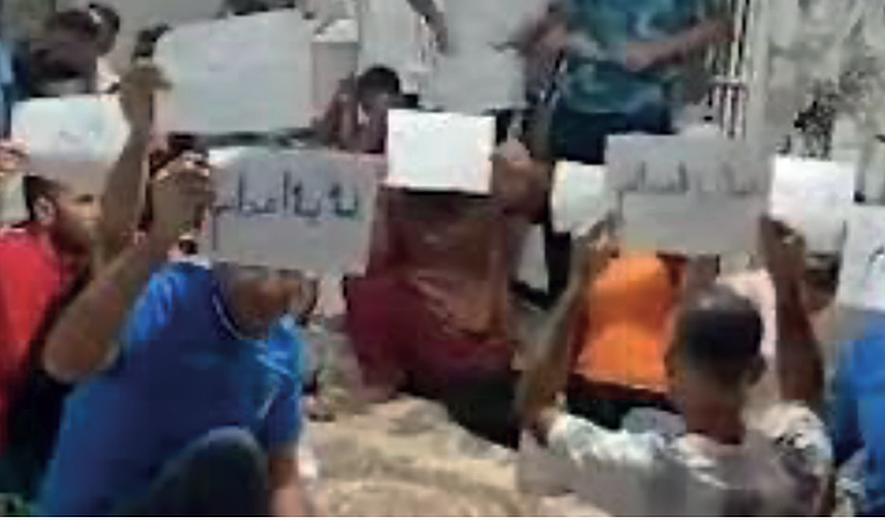
As the number of executions dramatically increased in 2025, authorities attempted to crackdown on campaigns to save death row prisoners. To do so, drug defendants were warned that they would face expedited executions if news of their cases leaked outside of prison walls. Yet, when six more prisoners were transferred to the pre-execution cells of Ghezelhesar Prison, drug death row prisoners in Ghezelhesar Prison chose to risk death for a chance to live. On 13 October 2025, more than 1500 drug death row defendants in Ward 2 of Ghezelhesar Prison went on a mass strike, sewing their lips, they sat defiantly in the ward’s common hall. For six days, they held their ground, refusing to back down despite so many reaching dangerous levels.
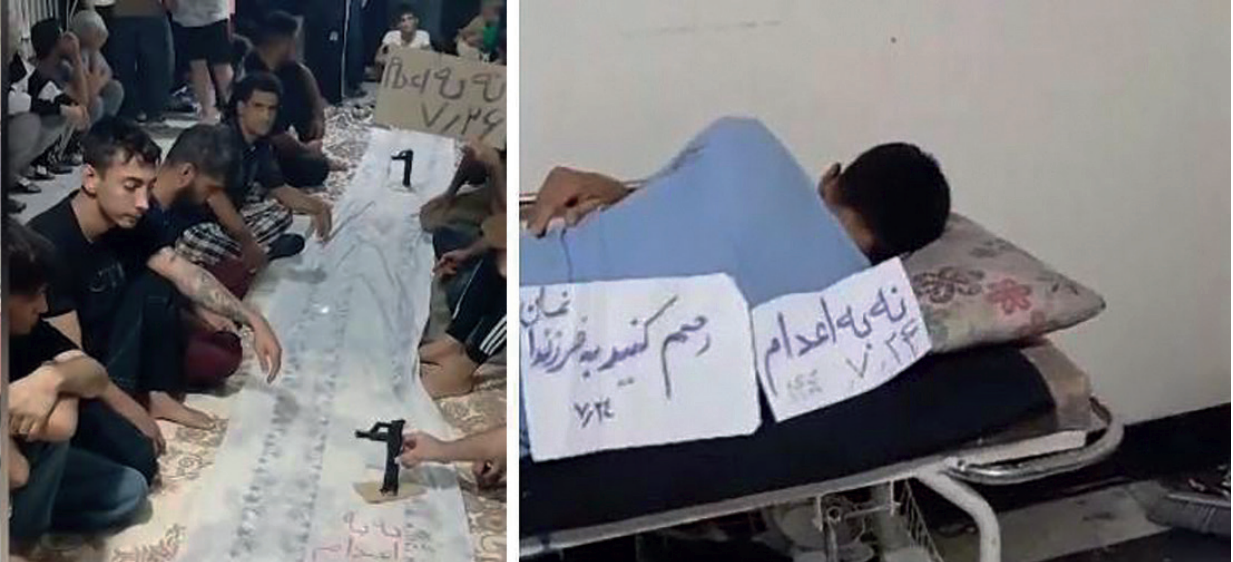
Left photo: Prisoners sitting in the common hall with “no death penalty” written on their empty tablecloth and signs, and small gallows to represent their protest. Right photo: too weak to sit, a prisoner with signs that read: “no death penalty” and “have mercy on our children.”
At the same time, families of the death row prisoners gathered outside parliament with the slogans “don’t execute” and “no death penalty.” In the end, it was the prison authorities who had to back down in the face of their unity and resistance. On the sixth day, a group of officials came to the prison, promising to halt drug executions until a new amendment was introduced. At the time of writing, no drug-related executions have been recorded at Ghezelhesar Prison.
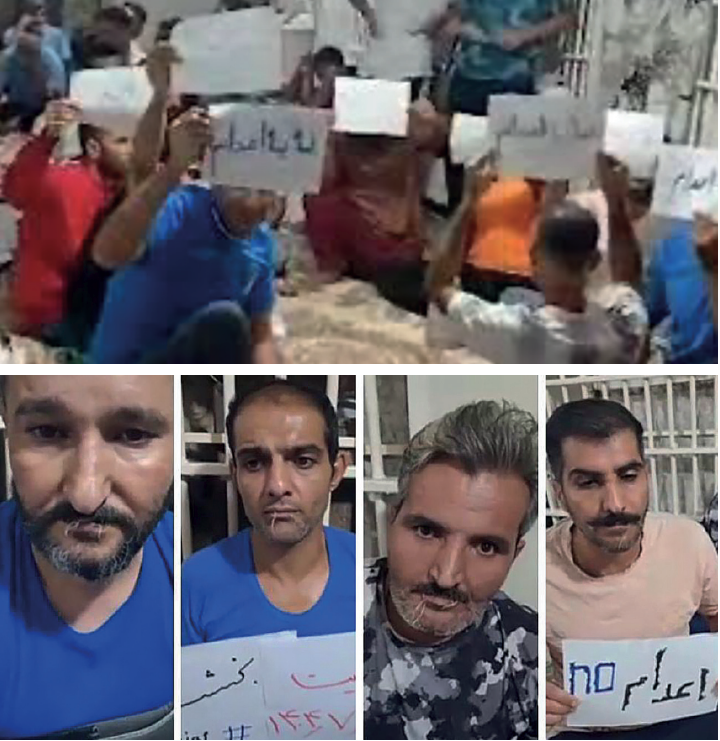
Top photo: Prisoners holding up signs that read “no death penalty.” Bottom photos: Prisoners with their lips sewn shut in protest.
No Death Penalty Tuesdays
After bearing witness to months of weekly group executions in Karaj, the execution of several political prisoners in January 2024, and the crackdown of the protest by ordinary crimes prisoners, a group of brave political prisoners[1] in Ghezelhesar Prison staged a protest which was also violently suppressed. The diverse group of political prisoners from different backgrounds and beliefs thus began a weekly hunger strike on 30 January 2024 that became known as “Black Tuesdays”[2] and later as “No Death Penalty Tuesdays.”[3] They chose Tuesdays for that is the day death row inmates are typically transferred to solitary confinement in preparation for the gallows in Ghezelhesar Prison. Despite crackdowns and punitive measures, the “No Death Penalty Tuesdays” movement persevered and soon began spreading to other prisons across the country. At the time of writing, 56 prisons are taking part in the weekly mass hunger strikes.
In 2025, 143 of the 174 executions carried out in Ghezelhesar Prison and 538 executions (32%) of all executions were carried out on Wednesday.
[1] The “No Death Penalty Tuesdays” hunger strikes were started by Ghezelhesar political prisoners Zartosht Ahmadi Ragheb, Loghman Aminpour, Meisam Dahbanzadeh, Jafar Ebrahimi, Sepehr Emam Jomeh, Ahmadreza Haeri, Reza Mohammad Hosseini, Saeed Masouri, Reza Salmanzadeh and Hamzeh Savari (listed in alphabetical order).
[2] IHRNGO, “Black Tuesdays” Prison Hunger Strikes Against the Death Penalty, 20 March 2024, https://iranhr.net/en/articles/6625/
[3] IHRNGO, 85+ Executions in 20 Days; IHRNGO Urges International Solidarity With “No Death Penalty Tuesdays” Movement, 20 August 2024, https://iranhr.net/en/articles/6870/
More from @ihrights
IHRNGO is building a strong civil society, through empowerment of the citizens, promoting and defending the human rights.
Latest Cartoon
Latest Report