Ehsan Faridi
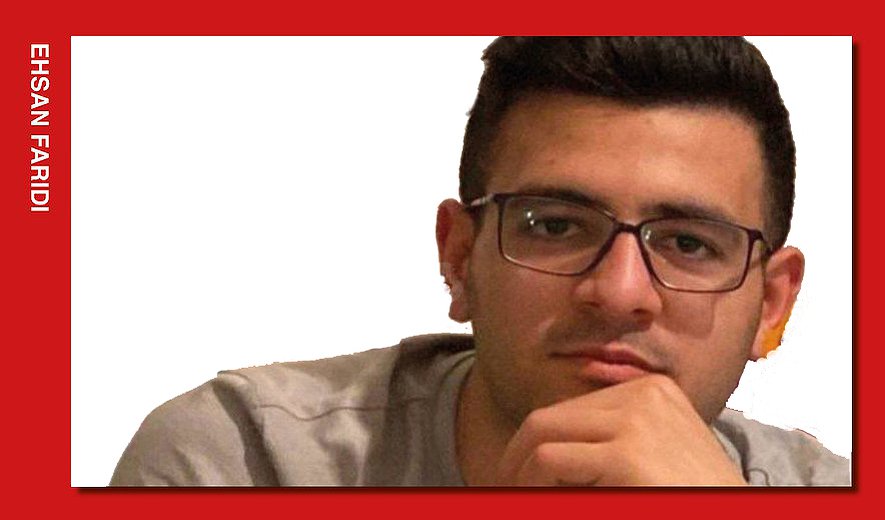
Ehsan Faridi is a 22-year-old Manufacturing Engineering student at Tabriz University who was arrested in the early hours of 13 March 2024, the night of Chaharshanbe Souri (Iranian fire festival). In an interview with Ensaf News, Ehsan’s new lawyer, Mahmoud Behzadi-Rad said his client was arrested by local police “approximately 3 kilometres from the courthouse and moving in the opposite direction from that building, while carrying two Molotov cocktails.”
The police report described the arrest “like a Hollywood movie,” alleging an “explosive vest” or a “military weapon”, which the lawyer says referred to approximately 50 grams of gunpowder. The same report, he adds, recorded no actual damage to public property but nonetheless imputed an intent to burn the courthouse. Ehsan was released on bail nine days later and subsequently appeared in court in the month of Tir (21 June-21 July 2024), where unsolved incidents from previous years in Tabriz were attributed to him and he was instructed to obtain letters of forgiveness from institutions he said he did not even know. After angering the judge while disputing this demand, his bail was revoked and the charges were escalated from “attempted moharebeh” to moharebeh (enmity against God) and efsad-fil-arz (corruption on earth) through links to the PMOI/MEK.
Behzadi-Rad cites multiple due process violations, including that the defence was given only a few pages of the case file and denied full access, and that the court failed to observe Article 387 of the Code of Criminal Procedure, which requires a ten-day window in death or life-imprisonment cases to submit objections and new evidence. He further argues the court ignored the proviso to Article 286 of the Islamic Penal Code, under which, if intent to cause widespread public disorder is not established, the punishment should be five to six years’ taʿzir; he notes the arrest occurred around 4:30 am, when no public was present to be terrorised. In parallel proceedings, Branch 108 of the Criminal Court imposed 18 months’ imprisonment for the Molotov-cocktail offence, yet the Revolutionary Court treated the same conduct as efsad-fil-arz and issued a death sentence.
A retrial request filed on 13 October 2025 was sent to a chamber on 14 October and rejected at 12:50 pm the same day. Earlier, the Supreme Court had upheld the death sentence amid so-called “wartime conditions.” The lawyer stated: “They probably didn’t even read my eight-page retrial petition! I suspect that, to boost end-of-month statistics, they dismiss many cases without due attention so that benefits accrue to the staff of that chamber.”
The defence intends to appeal again, seeking transfer away from Branch 29, and has written to the allegedly damaged entities for loss figures. No responses have been received, which the lawyer argues indicates no demonstrable harm. He also contests characterising Molotov cocktails as “military weapons”, citing the Paris Yellow Vests protests as an example: “In the Yellow Vests protests, tens of thousands of Molotov cocktails might be thrown. Does that mean tens of thousands of people should have been charged with moharebeh and, if they were in Iran, executed? They set fire to thousands of police cars; the harshest sentence handed down was two months in prison, and that was because several police officers had been beaten!” Behzadi-Rad maintains that these procedural and substantive defects necessitate quashing the death sentence and ordering a fair rehearing.
In a video message obtained by IHRNGO from Ehsan’s parents, his mother, Parvin Hayati says: “My son was under 20 at the time of his arrest, and for 17 months he has breathed life behind prison bars, suspended between hope and fear. I kept silent for two years, but now I can no longer stay silent. Silence in the face of injustice is a betrayal. Ehsan is innocent. There is no evidence against him. I am a young mother whose only wish is that my child stays alive. I swear on Ehsan’s life and on the lives of all the innocent young people [on death row] that I will not rest until the unconditional release and an acquittal for my dear Ehsan, and I hope no mother, in such torment, is forced to go to such extremes to save her child’s life.”
CHARGES: Efsad-fil-arz (corruption on earth) through membership of the People's Mojahedin Organisation of Iran (PMOI/MEK)
STATUS: Sentenced to death by Branch 3 of the Tabriz Revolutionary Court, presided over by Judge Hassan Fathpour, which was upheld by the Supreme Court in early October 2025. His appeal was rejected on 14 October.
More from @ihrights
IHRNGO is building a strong civil society, through empowerment of the citizens, promoting and defending the human rights.
Latest Cartoon
Latest Report