Child Offenders Executed in Iran in 2024
This is an extract from the 2024 Annual Report on the Death Penalty in Iran.
Child offender executions: Trends and legislative reforms
The 2013 IPC retained the death penalty for child offenders. Although Articles 89-95 suggest corrective measures and alternative punishments for children and juveniles, Article 91 is very clear that the offences punishable by hudud or qisas are exceptions to this rule. It is important to note that almost all juvenile offenders executed in the past 11 years were sentenced to death based on qisas and hudud laws.
Article 91 states: “For offences punishable by hadd or qisas, mature persons younger than 18 shall be sentenced to the punishments stipulated in this chapter (Articles 89-95) if they do not understand the nature of the offence committed or its prohibition or if there are doubts about their maturity or development of their reasoning.”
The Article grants discretion to the judge to decide whether a child offender understood the nature of the offences, whether they were mature at the time of committing the offence and whether they should be sentenced to death. The Note to Article 91 authorises but does not require the court to seek the opinion of the Forensic Medical Organisation or to use any other means to reach a verdict.
Moreover, while Article 146 states that immature persons lack criminal responsibility, Article 147 repeats the provisions of the previous law and the Civil Code regarding maturity and the age of criminal responsibility. Girls are considered mature at the age of 9 lunar years and boys at the age of 15 lunar years. A girl older than 8.7 years and a boy older than 14.6 years can therefore be sentenced to death.
In the framework of the Universal Periodic Review (UPR), Iranian authorities wrote in their reply to the recommendations: “Conforming to the recent amendments made in the laws of Iran, the maximum punishment for children shall not exceed five years of detention in correctional facilities. The deprivation of life as a punishment shall be proposed but not enforced in case the culprit with the age of criminal responsibility has not perceived the nature of the crime and therefore lacks mental maturity and perfection, based on the expert assessment and judgement of the competent court.”[1]
Mehdi Jahanpour, a juvenile offender who was 16 years old at the time of his alleged offence, was kept in prison or correctional facilities until he reached the age of 18 before being executed in 2024.
Iran is one of the last remaining countries to sentence child offenders to death and executes more child offenders than any other country in the world. In violation of the International Convention on the Rights of the Child (CRC), which Iran has ratified, Iranian authorities executed at least one child offender in 2024. According to IHRNGO reports, at least 71 juvenile offenders were executed between 2010 and 2024 in Iran.[2]
Due to lack of transparency in the Iranian Judiciary, there is no information about the number of child offenders on death row in Iranian prisons. However, according to a 2021 report by UN experts, at least 85 juveniles could be on death row in Iranian prisons.[3]
International pressure on Iran on this issue increased during the first decade of the 2000s. As a consequence of the criticism from the international community and domestic civil society, Iran made changes regarding child offenders in the 2013 Islamic Penal Code (IPC). However, these changes have not led to a decrease in the number of child offender executions. The 2013 IPC explicitly defines the “age of criminal responsibility” for children as the age of maturity under Sharia law, meaning that girls over 9 lunar years of age and boys over 15 lunar years of age are eligible for execution if convicted of “crimes against god” (such as apostasy) or “retribution crimes” (such as murder). Article 91 of the IPC states that offenders under the age of 18 who commit hudud or qisas offences may not be sentenced to death if the judge determines the offender lacked “maturity or development of their reasoning” based on forensic evidence.[4] The article allows judges to assess a juvenile offender’s mental maturity at the time of the offence and, potentially, to impose an alternative punishment to the death penalty on the basis of the outcome. In 2014, Iran’s Supreme Court confirmed that all child offenders on death row could apply for retrial.
However, Article 91 is vaguely worded and inconsistently and arbitrarily applied. Between 2016 and 2024, IHRNGO identified 22 cases where the death sentences of juvenile offenders were commuted based on Article 91. In the same period, at least 32 juvenile offenders were executed according to reports received by IHRNGO and several remain at risk of execution. It seems that Article 91 has not led to a decrease in the number of child offender executions. The Iranian authorities must change the law, unconditionally removing all death sentences for all offences committed under 18 years of age.
In his 2024 report, Javaid Rehman, former UN Special Rapporteur on the situation of human Rights in the Islamic Republic of Iran expressed alarm “by the sentencing of children to death and regret[ted] that no progress has been observed towards the implementation of the recommendations made by him and his predecessors, other special procedure mandate holders and international human rights mechanisms that the death penalty for children be abolished, regardless of the circumstances and nature of the crime committed.” He called on the Islamic Republic to “urgently amend legislation to prohibit the execution of persons who have committed a crime while under the age of 18 and urgently amend legislation to commute all death sentences for child offenders.”[5]
In his June 2024 report to the 56th session of the Human Rights Council, the UN Secretary-General called on Iran’s government to “prohibit the execution of all offenders who were under the age of 18 at the time of the crime, in all circumstances, and commute their sentences.”[6]
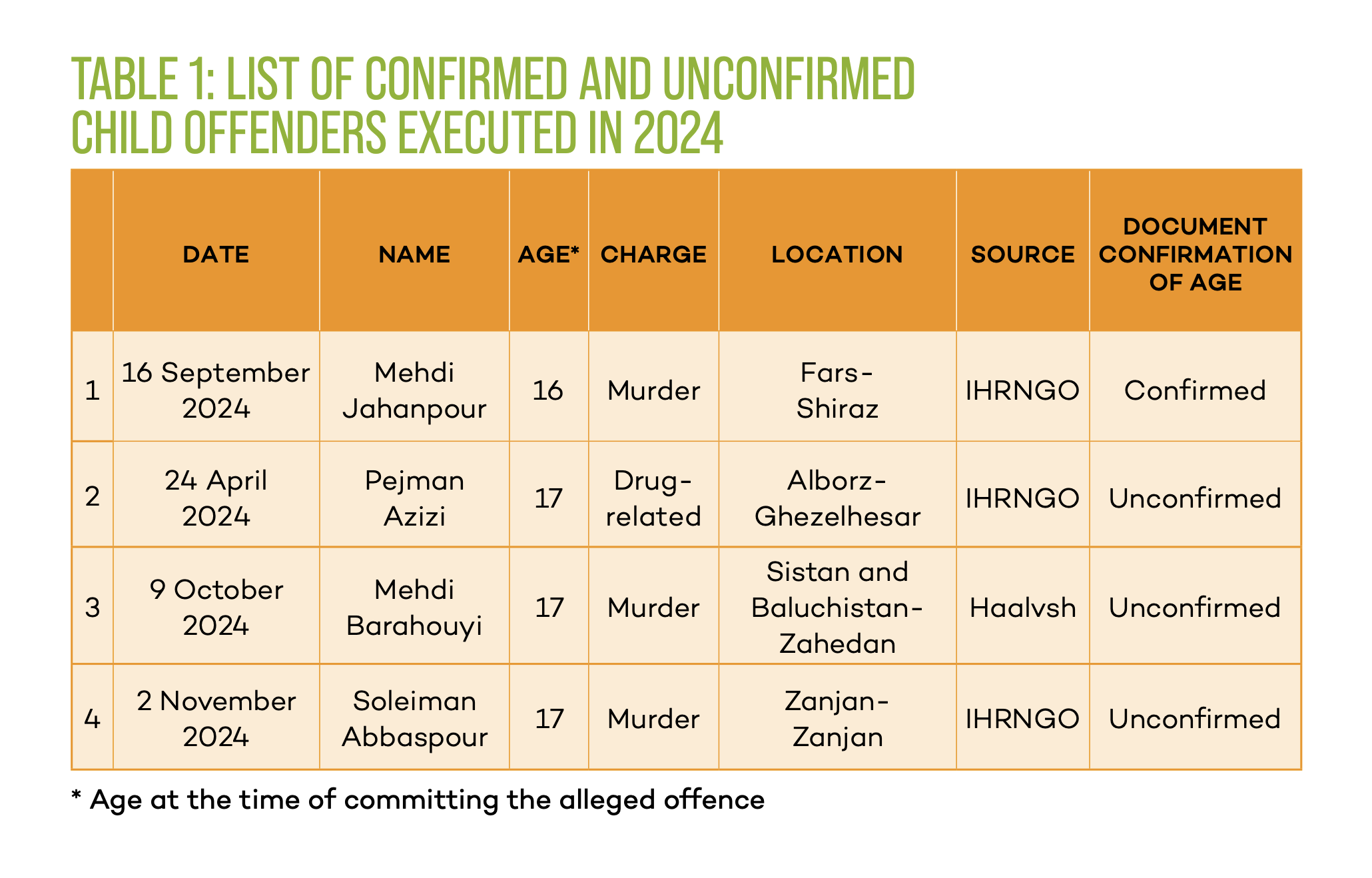
Facts about child offender executions in 2024
- 1 confirmed child offender was executed for murder charges
- 3 others executed in 2024 are believed to have been child offenders which IHRNGO has been unable to verify at the time of writing
- Of the 3 unconfirmed cases, 2 were on death row for murder and one for drug-related offences
- None of the 4 executions were reported by official sources
Juvenile offenders executed in 2024
Mehdi Jahanpour

Mehdi Jahanpour was born on 8 December 2002 and was 16 years old at the time of his arrest in Firouz Abad (Fars province) in April 2019. On the day of the alleged offence, he had been stopped in the street by a man who was in love with the same girl as him. In the fight that pursued, Mehdi was accused of killing the other man with a knife. He was sentenced to qisas and held behind bars until 16 September 2024 when he was executed in Shiraz Central Prison in Fars province. Mehdi was just shy of 22 years old at the time of his execution.[7]
Soleiman Abbaspour

Soleiman Abbaspour was reportedly 16 years old when he had to defend himself against a drunk man attempting to rape him, a fact that he stated in court. However, the court not only denied his defence but also the fact that he was under 18 years old at the time of the alleged offence. He was sentenced to qisas by the Criminal Court and held in Zanjan’s Correctional Central for four years. At the age of 21, he was transferred to Zanjan Central Prison, Zanjan province, and executed on 2 November 2024.[8]
[1] Human Rights Council, Report of the Working Group on the Universal Periodic Review, Islamic Republic of Iran, Addendum, Views on conclusions and/or recommendations, voluntary commitments and replies presented by the State under review, 20 February 2020, op. cit.
[2] Iran Human Rights Execution Counter, https://iranhr.net/en/
[3] Iran: UN experts say executions of child offenders must stop, 25 November 2021, https://www.ohchr.org/en/press-releases/2021/12/iran-un-experts-say-executions-child-offenders-must-stop
[4] Situation of human rights in the Islamic Republic of Iran, Report of the UN Secretary-General, 10 September 2013, A/68/377, https://undocs.org/A/68/377. See also Iran Penal Code (2013), Art. 91
[5] UN Special Rapporteur on the situation of human rights in the Islamic Republic of Iran, Javaid Rehman, Situation of human rights in the Islamic Republic of Iran, 2024, op. cit.
[6] Situation of human rights in the Islamic Republic of Iran, Report of the Secretary General, 19 June 2024, A/HRC/56/22, https://docs.un.org/en/A/HRC/RES/56/22 .
[7] IHRNGO, Executed Mehdi Jahanpour was a Child Offender; 71+ Child Offenders Hanged in Iran since 2010, https://iranhr.net/en/articles/6936/
[8] IHRNGO, Possible Child Offender Soleiman Abbaspour and Ezat Seyedi Executed in Zanjan, 7 November 2024, https://iranhr.net/en/articles/7094/