Three Years After Jina Amini’s State-Killing: Nearly 3,000 Executed
Iran Human Rights (IHRNGO); September 16, 2025: Three years have passed since the day Jina (Mahsa) Amini, a 22-year-old Kurdish woman, passed away in hospital after being beaten at the hands of the Guidance Patrol (morality police) in Tehran. Her state-killing led to one of the biggest nationwide protests against the Islamic Republic.
In the bloody crackdown that ensued, the Islamic Republic killed at least 551 protesters including 68 children, and systematically targeted protesters’ eyes, leaving many blind. IHRNGO analysis of protester deaths and eye injuries during the “Woman, Life, Freedom” nationwide protests revealed that repressive forces intentionally and systematically targeted women’s eyes and faces.
Furthermore, on 30 September 2022, a day that became known as “Bloody Friday,” at least 104 people including 14 children and four women were gunned down with assault rifles and machine guns after worshippers gathered to protest after Friday prayers in Zahedan.
Beyond direct repressive measures, the Islamic Republic has intensified its use of the death penalty to instill societal fear. According to IHRNGO data, at least 2910 people including 83 women have been executed in Iran since 16 September 2022, an average of 970 executions per year.
37 prisoners of conscience, 14 protesters (12 of them “Woman, Life, Freedom” protesters) and 4 child offenders were amongst those executed. More than half of those executed were drug defendants, who are amongst the most vulnerable groups in society. A disproportionate number of Baluch people are represented in drug-related executions.
IHRNGO Director, Mahmood Amiry-Moghaddam stated: “While the majority of those executed by the Islamic Republic’s execution machine are convicted of non-political crimes, the purpose of these executions is political repression and the intimidation of society to deter future protests. The Islamic Republic’s Supreme Leader is acutely aware that future nationwide protests could lead to the downfall of his rule.” He added: “Given that the vast majority of those sentenced to death are subjected to torture and ill-treatment and are denied the right to a fair trial, the execution of nearly three thousand people, carried out without due process and aimed at instilling public fear, must be investigated by the UN Fact-Finding Mission as a clear instance of crimes against humanity.”
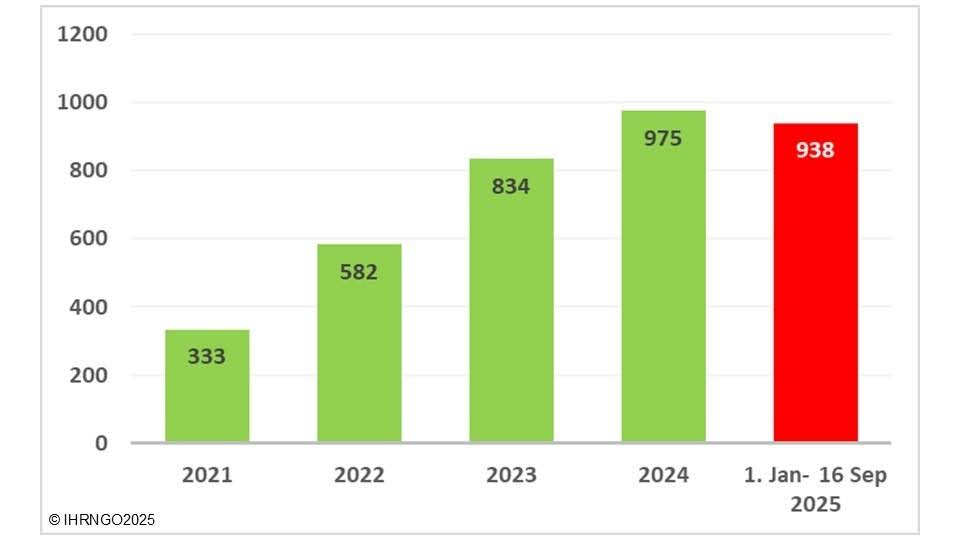
A review of IHRNGO’s Annual Reports on the Death Penalty in Iran reveals a sharp rise in executions since 2022, the year of Jina Amini’s state-killing and the start of “Woman, Life, Freedom” nationwide protests. While the majority of those executed were convicted of ordinary crimes, the Islamic Republic has demonstrated that it deliberately targets the most vulnerable members of society for execution, aiming to spread societal fear while incurring the lowest possible political cost.
Accordingly, it is essential that both the Iranian people and the international community pay close attention to the issue of capital punishment and work to raise the political cost of the executions for authorities.
As of the time of writing, at least 938 people have been executed in Iran in 2025. With three and a half months remaining, it is highly likely that the Islamic Republic will break its execution record of the past three decades.
IHRNGO has compiled and continually updates a list of death row prisoners which can be found here.
At least 12 “Woman, Life, Freedom” protesters have been executed:
Mohsen Shekari, Majidreza Rahnavard, Mohammad Mehdi Karami, Mohammad Hosseini, Saleh Mirhashemi, Saeed Yaghoubi, Majid Kazemi, Milad Zohrevand, Mohammad Ghobadlu, Reza Rasayi, Mojahed Kourkour and Mehran Bahramian.