Forced Televised Confessions in 2025
This is an excerpt from the 2025 Annual Report on the Death Penalty in Iran.
The Islamic Republic has used televised confessions as a propaganda tool aimed at creating fear and justifying the heavy sentences handed down to its political opponents and activists since its inception in 1979. Such confessions are extracted after physical and/or psychological torture, lengthy solitary confinement, threats or promises of reduction in the gravity of sentences and threats against family members. The confessions are often aired after arrest, following public protests to a sentence, or immediately prior to or after the execution as a means of reducing backlash. Airing the forced confessions before trial is a clear violation of the defendants’ right to be presumed innocent until proven guilty and fair trial rights.
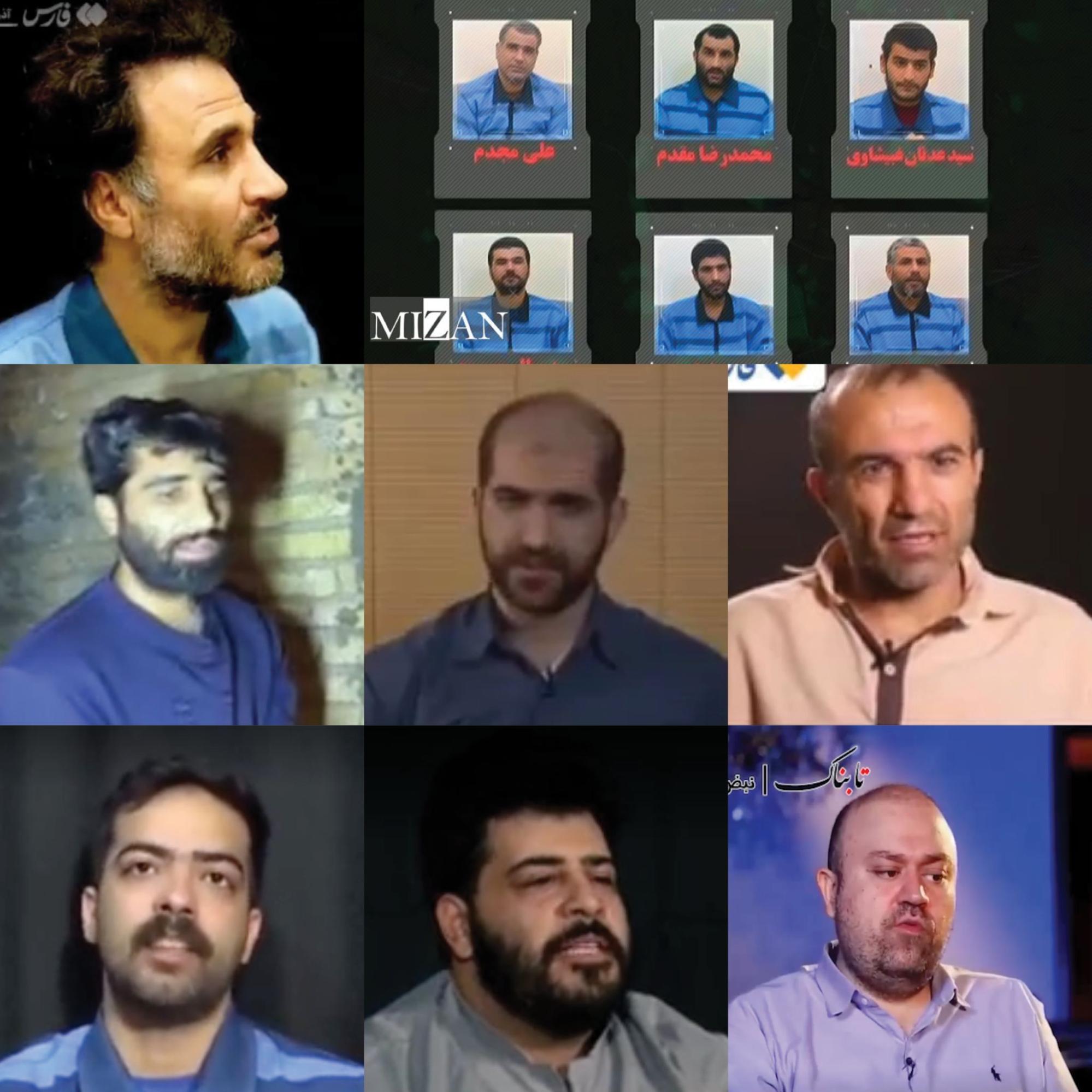
Forced televised confessions of some of those executed in 2025. Top left to right: Hamid Hosseinnejad Haydaranlu. Ali Mojadam, Mohammadreza Moghaddam, Adnan Ghabishavi, Salem Mousavi, Moein Khanfari and Habib Deris. Middle left to right: Mehran Bahramian, Saman Mohammadi Khiareh and Mojahed Kourkour. Bottom left to right: Aghil Keshavarz, Mohsen Langarneshin and Rouzbeh Vadi.
In 2025, state media aired the forced confessions of protesters Mehran Bahramian and Mojahed Kourkour; Arab political prisoners Ali Mojadam, Mohammadreza Moghadam, Adnan Ghabishavi, Moein Khanfari, Habib Deris and Salem Mousavi; Kurdish political prisoners Hamid Hosseinnejad Haydaranlu and Saman Mohammadi Khiareh; espionage defendants Aghil Keshavarz, Mohsen Langarneshin and Rouzbeh Vadi.
At trial, not only are forced confessions used as evidence of guilt, but under threats and coercion, the defendants are often forced to repeat the false accounts in court. Once the defendant has been found guilty, their forced confessions are again used as a propaganda tool to justify their death sentences and to instil fear among the population. Forced confessions are also aired post-execution to justify the inhumane punishment of death. This was the case for the defendants executed for espionage charges in 2025.
On 19 January 2023, the EU Parliament adopted a resolution in which it strongly condemned “the Islamic Republic’s policy of forcing confessions using torture, intimidation, threats against family members or other forms of duress, and the use of these forced confessions to convict and sentence protesters.”[1]
[1] European Parliament resolution of 19 January 2023 on the EU response to the protests and executions in Iran, op. cit.