Public Executions in 2025
This is an excerpt from the 2025 Annual Report on the Death Penalty in Iran.
For 46 years, Iran has been one of the few countries in the world to carry out executions in public spaces. Public executions have been repeatedly criticised by the international community and domestic civil society in Iran. Both the UN Secretary General and the Special Rapporteur on the Human Rights Situation in the Islamic Republic of Iran have expressed concern about the continued practice of public executions. During Iran’s second UPR,[1] the government rejected recommendations aimed at ending public executions.[2] [1] [2] Criticism of the Islamic Republic’s practice of public executions has also been emphasised in previous Special Rapporteur reports.[3]
Following massive media attention and international pressure in 2007-2008, then Head of Judiciary, Mahmoud Shahroudi issued an order calling for limitation in the use of public executions. Consequently, the number of public executions in 2008-2010 were relatively lower than in previous years. However, following the post-election protests of 2009, the number of public executions increased dramatically after 2010, reaching an annual average of 50 to 60 between 2011-2015. With increased international focus again, the number of public executions decreased to 33 in 2016, 31 in 2017 and then 13 in 2018 and 2019. Public executions dropped significantly during the COVID-19 pandemic, with one execution reported in 2020 and none in 2021. In 2022, two people were publicly hanged and the number more than tripled in 2023, with seven public executions. In 2024, there was a slight decrease, with four public executions. Public hangings more than tripled in 2025, with eleven being recorded.
Public executions are also a way to instil fear among the population and have consequences on the mental health of people who attend. Public executions are always officially reported, though defendants are often not named or are only identified by their initials. In cases that are reported by official sources, in addition to their names, photos and videos are also published.
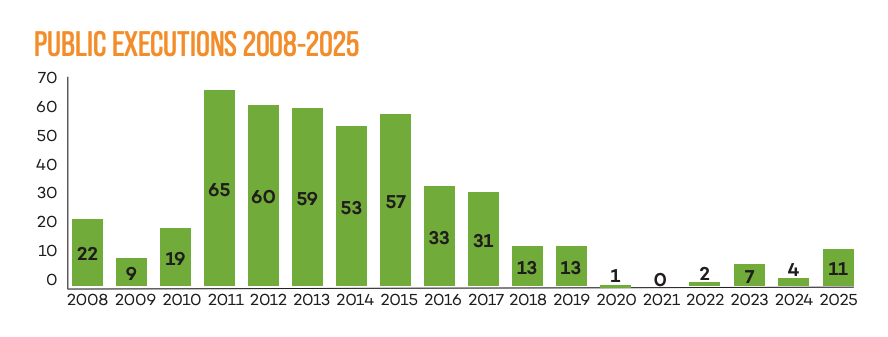
The diagram above shows public executions since 2008. The number of public executions in 2020 was significantly lower due to COVID-19 pandemics restrictions, and no public executions were recorded in 2021. Since 2022, public executions have been rising again. In 2025, at least 11 people were hanged in public spaces, almost triple the number in 2024.
Executed in public in 2025
In 2025, at least 11 men were hanged in public spaces across the country. Of those, ten were announced by official media. The public hanging of Mohammad Zakeri was not announced by official sources.[4]
Ilia Khalifehzadeh
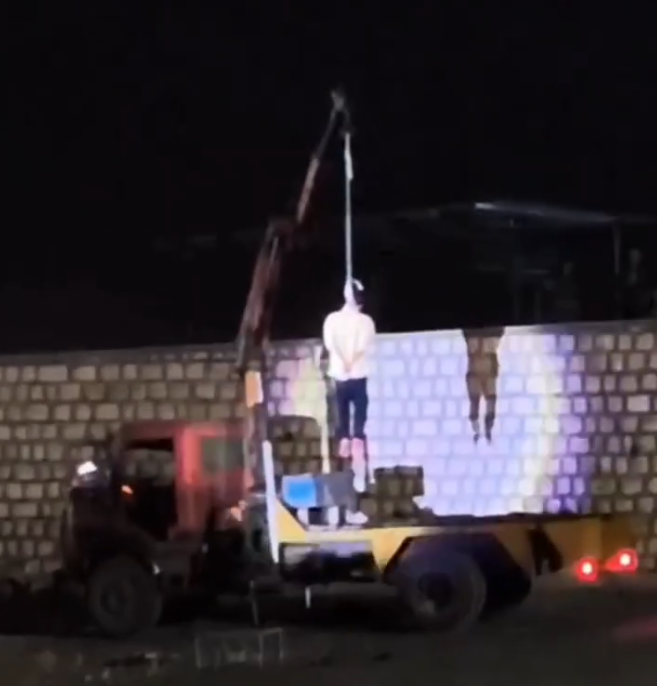
Ilia Khalifehzadeh was a 20-year-old man arrested in 2024. He was sentenced to death on charges of rape that led to the death of a 7-year-old girl. He was publicly hanged in Bukan on 12 July 2025. Videos of the public hanging showed the presence of children at the scene.[5]
Sajad Molayi Hakani
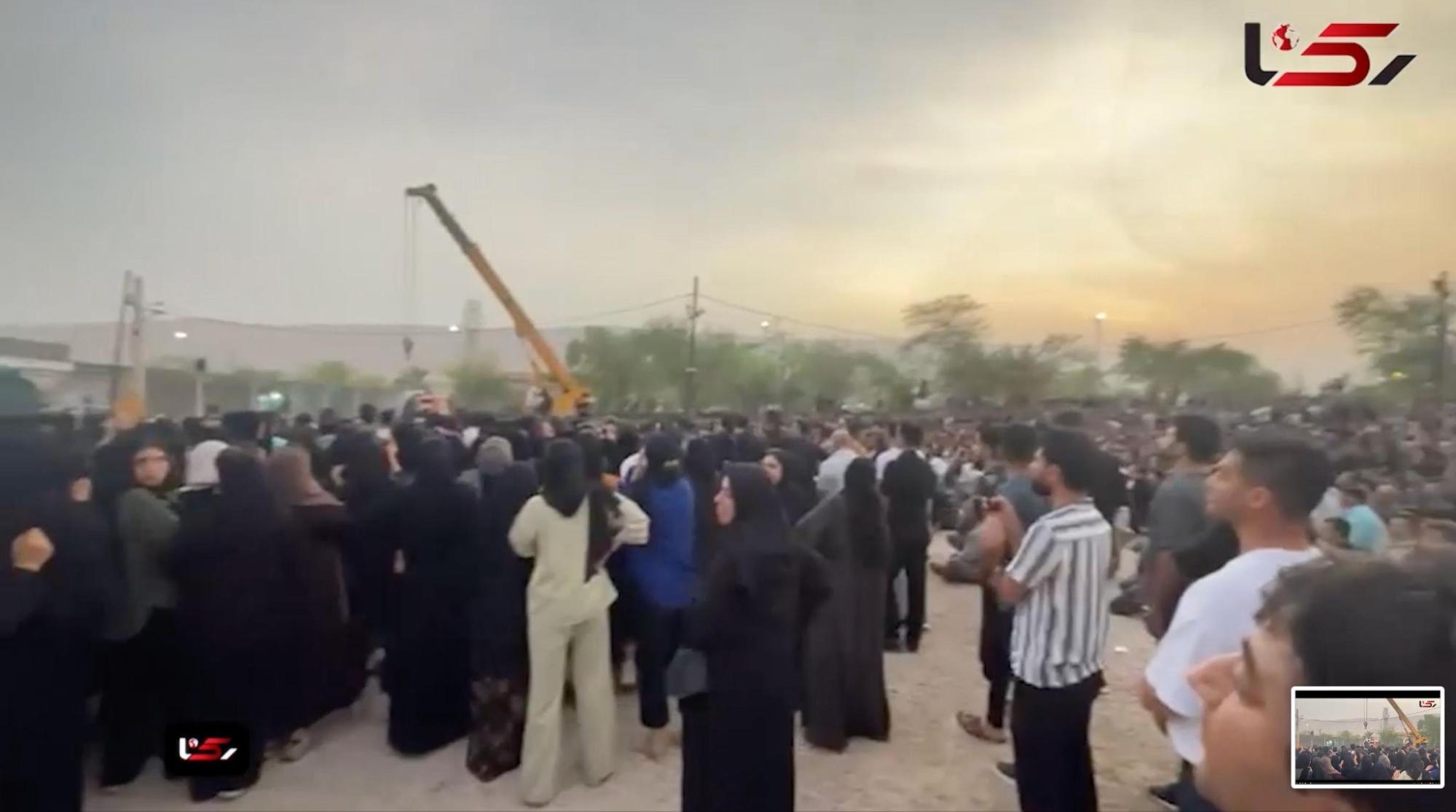
Sajad Molayi Hakani was arrested with his wife for the murder of a mother and her three children in the course of a robbery in October 2024. They were both sentenced to qisas by Branch 1 of the Fars Criminal Court. On 19 August, he was publicly hanged in Beyrom, a town with less than 8000 inhabitants. Video footage published by state media showed the presence of many children at the scene.[6] His wife, Mahsa Akbari, who was a child bride, was hanged in Shiraz Central Prison in the presence of the victim’s next of kin on 20 August 2025.[7]
[1] UN Human Rights Council, Outcome of the universal periodic review: Islamic Republic of Iran, 28 May 2015, A/HRC/DEC/28/108, https://ap.ohchr.org/documents/dpage_e.aspx?si=A%2FHRC%2FDEC%2F28%2F108
[2]OHCHR, UPR of the Islamic Republic of Iran - Second Cycle Thematic list of recommendations, https://www.ohchr.org/sites/default/files/lib-docs/HRBodies/UPR/Documents/Session20/IR/IranMatriceRecommendations.doc
[3] UN Special Rapporteur on the situation of human rights in the Islamic Republic of Iran, Javaid Rehman, Situation of human rights in the Islamic Republic of Iran, 7 February 2023, op. cit.
[4] https://iranhr.net/en/articles/8474/
[5] https://iranhr.net/en/articles/7738/
[6] https://iranhr.net/en/articles/7884/
[7] https://iranhr.net/en/articles/7887/
[1]No recommendations on public executions during the 4th UPR cycle. Check the third.
[2]i don't think there was one in 2023 either otherwise we would've used it last year?