Ignoring the Environment in Transition Invites Disaster
Ignoring the Environment in Transition Invites Disaster
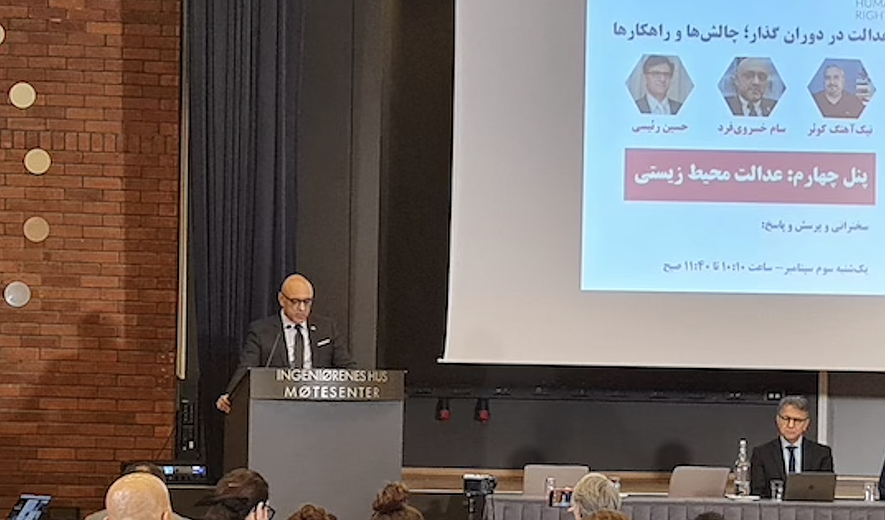
“Neglecting the environment during political transition can have disastrous consequences for society and nature.” So warned Sam KhosraviFard, an environmental scientist and analyst, at the conference "Justice in Transition: Challenges and Solutions", hosted by the Iran Human Rights Organisation at the University of Oslo in September 2023.
Drawing on Iran’s own history and international examples, he stressed that political turmoil and instability often push environmental concerns to the margins—with costs that reach far beyond damaged ecosystems to human health and livelihoods.
When politics trumps nature
Iran’s experience after the 1979 revolution, Khosravifard observed, illustrates how quickly nature is sacrificed in moments of upheaval. Protected areas were raided, wildlife destroyed and land seized. Wetlands were deprived of their water, while industries dumped waste untreated into rivers and fields. Even the Department of the Environment came close to abolition, branded a royalist institution. Only the resistance of experts prevented its demise.
Iran is not unique. After the fall of Suharto in 1998, Indonesia saw a surge in deforestation. Prolonged instability in Sudan led to poaching and habitat loss. In Latin America, from Brazil to Venezuela, social unrest has weakened enforcement of environmental rules. In each case, the pattern is the same: nature pays the price of power struggles.
Pollution and profiteering in fragile states
Khosravifard highlighted another danger: irreversible pollution. In transitional periods, governments lack the capacity or will to enforce protections, allowing crises such as contamination of groundwater with heavy metals or radioactive waste. Even in stable times, these are difficult to remedy.
He cited Lebanon’s 2015 waste crisis, when the closure of Beirut’s main landfill left rubbish piling up in the streets for months. Public anger spawned the “You Stink” movement, but even that failed to push the state to overhaul waste management.
In such vacuums, powerful companies and lobbyists thrive. After Saddam Hussein’s fall, Iraq and the Niger Delta alike witnessed oil firms taking advantage of weak oversight, ignoring standards and ramping up extraction. “Political transition without environmental vigilance,” he argued, “does not just breed new crises, it burdens future generations with their fallout.”
Population pressures mount
The upheavals of transition also drive migration and demographic stress. In the western Mediterranean, the population nearly doubled between 2004 and 2009. Syria’s civil war added another million people to the region by 2011. An area already struggling to supply water to 1.6 million people was suddenly forced to meet the needs of more than 3 million.
Iran, he warned, is similarly vulnerable. Mismanagement of resources, drought and climate change leave the country ever more fragile. Without foresight, any political transition risks compounding the environmental crises already unfolding.
Towards a sustainable future
Yet solutions exist. Khosravifard urged greater public awareness and education, though he criticised Persian-language media for sidelining environmental issues because they “do not generate clicks”. He called for stronger public participation, noting how Iranian NGOs have piloted alternative livelihoods in protected areas, helping locals to see that their survival depends on conserving nature.
Opposition groups abroad, he suggested, could play a vital role by drafting frameworks for sustainable development and resource management to guide policymakers once stability returns. Above all, two principles should underpin future policy: grounding decisions in scientific evidence and adopting nature-based solutions.
As an example, he pointed to Frankfurt, where city authorities let wild plants colonise green spaces rather than managing them intensively. The result has been lower water use and a resurgence of insect life. For Iran and other fragile states, such modest, nature-led approaches could make the difference between resilience and collapse.
“Political transitions are testing times,” he concluded. “But without environmental foresight, they are not just politically fraught—they are ecologically ruinous.”
More from @ihrights
IHRNGO is building a strong civil society, through empowerment of the citizens, promoting and defending the human rights.
Latest Cartoon
Latest Report