Durable Democracy Requires a Secular State
Durable Democracy Requires a Secular State
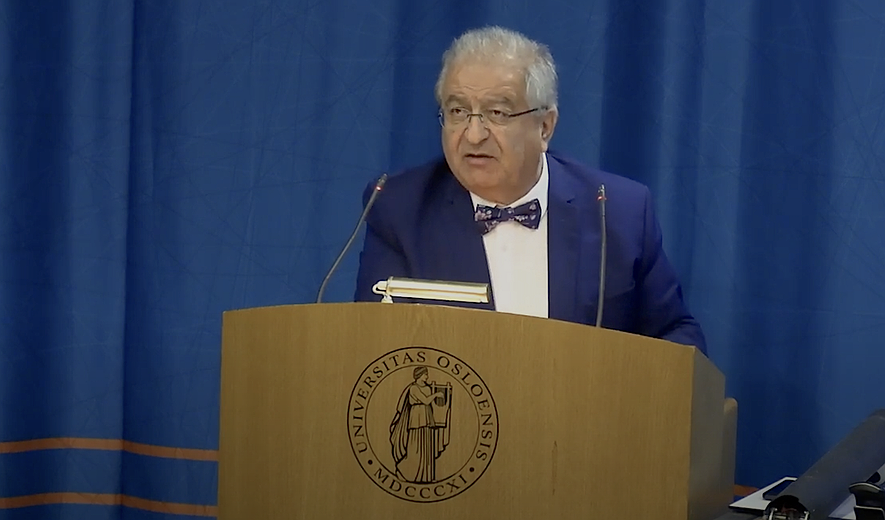
Jalal Idjadi, a sociologist, researcher and author, underlined the necessity of a complete separation between religion and state, arguing that “one of the main guarantees of democracy is a secular government that grants equal rights to all citizens without discrimination.”
Speaking at the"Transition and Safeguarding Citizens’ Rights in Iran" in Oslo on 31 August 2024, Idjadi described “Qur’anic Islam” as an ideological totalitarianism fundamentally incompatible with democracy and human rights. In his view, the 1979 revolution was from the outset an “Islamic fascism” that placed political and social structures under the dominance of a single totalitarian ideology.
He stressed that citizens are free to believe in any faith—or none—but the political system must not recognise any religion as a source of law or official privilege. Drawing a controversial comparison between the Qur’an and Hitler’s Mein Kampf, he claimed that both contain structures that reinforce domination and totalitarianism.
Referring to France’s 1905 law on laïcité, Idjadi explained that secularism is not hostile towards the faithful, nor does it restrict religious practice; it simply ensures that no religion enjoys special privileges in political power or the education system. “Islam and Shi’ism,” he declared, “must have no role in the political, educational or economic structures of the state.” He added that Islam had historically contributed to the decline of Iranian civilisation, and that a decisive separation of religion from politics is a precondition for democracy.
Iran, he emphasised, is a plural society, encompassing believers of different faiths as well as non-believers, and only a secular state can guarantee equal rights for all. He noted that the “Woman, Life, Freedom” uprising was inherently secular, with no place for religious slogans.
Finally, Idjadi pointed to the proliferation of political groups in exile, many of which invoke secularism in their declarations. Yet, he insisted, they must clarify their positions on education, religious institutions and faith-based funding. The constitution of a future Iran, he concluded, must make no reference to Islam or Shi’a jurisprudence.
Translated from Farsi via machine translation and lightly edited for clarity.
More from @ihrights
IHRNGO is building a strong civil society, through empowerment of the citizens, promoting and defending the human rights.
Latest Cartoon
Latest Report