Mahmood Amiry-Moghaddam’s Opening Speech at the Conference “Human Rights in Post–Islamic Republic Iran”
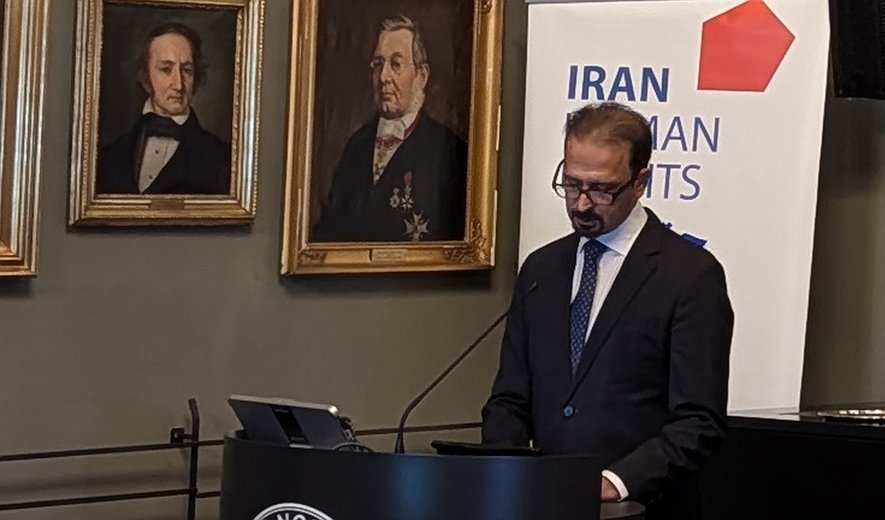
Ladies and gentlemen, dear friends,
Ladies and gentlemen, dear friends,
I greet you all and welcome you to the conference “Human Rights in Post–Islamic Republic Iran.”
Your presence here is a great honour for us.
We are holding this conference at a time when Iran and its people are experiencing one of the darkest—and at the same time most decisive—periods in their contemporary history. The Islamic Republic is an ineffective, corrupt and unstable government that not only lacks the ability to meet the most basic needs of the people, but through its policies and adventurism has pushed the country to the brink of war and destruction.
In the absence of popular legitimacy, repression and executions have become the Islamic Republic’s main tools for maintaining power. In the past ten months, nearly 1,200 people have been executed in Iran—meaning that approximately every six hours, a human being is put to death, without a fair trial, without transparency, and often in complete silence. Today, more than 1,500 prisoners in Qezel Hesar prison, many of them sentenced to death, are on the fifth day of a hunger strike. It is a protest from within prison against the regime’s machinery of death—and a cry of hope that the people of Iran and the international community will raise the cost of these crimes through their reaction.
The goal of these executions is not only physical elimination; it is also to create fear, helplessness and submission among the people in order to prevent protests.
However, the Islamic Republic does not rule solely through physical repression. It also seeks to destroy people’s hope for the future by fuelling division and tension among opponents of the regime—and by sending the message that the alternative to the Islamic Republic is chaos.
We are here today to give a clear answer to that claim: that forces opposed to the Islamic Republic—with all their differences, disagreements and even conflicting histories—are capable of sitting together and engaging in dialogue. A dialogue that is respectful, constructive and based on principles.
Iran Human Rights (IHRNGO) is the organiser of this meeting—not as a political actor, but as an independent human rights organisation. We are not affiliated with any political current, party or group. However, we consider it our duty, at this historic moment, to provide a neutral space for healthy and respectful dialogue. For us, it is not important what the future political structure of Iran will be; what matters is respect for human dignity and the guarantee of human rights for all Iranian citizens.
Iran is a land with a diverse population: Baloch and Persian, Kurd and Turk, Arab, Turkmen, Lur, and many other languages and identities; Shi’a Muslims, Sunnis, Bahá’ís, Zoroastrians, Christians, Jews, Yarsanis, atheists or non-believers; women and men, or members of the LGBT community; people with different political orientations or none at all. All of these individuals have the right to live freely and with dignity in their own country.
The purpose of this meeting is not to form a political coalition or to unify the opposition. We have gathered to discuss minimum human rights principles—principles that can serve as the foundation of any future political structure in Iran, regardless of the form of government or the composition of political forces.
In a world where dialogue has become rare, and in an environment where social media has turned into a battlefield, the ability to sit together and listen to one another is a courageous and hopeful act. Dialogue is not a sign of weakness; it is a sign of political maturity and respect for the people.
The outcome of this meeting may be consensus on a set of human rights principles, or the creation of a framework for continuing dialogue. Even if we do not reach a final agreement, the fact that representatives of different political currents have been able to sit together and respectfully speak about their differences and concerns sends a powerful message to the people of Iran:
That a transition to a better future is possible.
And finally,
The diversity present in this gathering—of views, backgrounds, languages and identities—reflects the beautiful diversity of Iranian society.
Our hope and belief is that in a future Iran, every citizen—regardless of gender, language, religion or political belief—will enjoy equal rights and equal opportunities.
With hope for that day,
And with thanks to all of you for your presence and participation.
Translated from Farsi via machine translation and lightly edited for clarity.
More from @ihrights
IHRNGO is building a strong civil society, through empowerment of the citizens, promoting and defending the human rights.
Latest Cartoon
Latest Report