Mohtadi Warns of Deepening Power Rift in Tehran and Urges Opposition Unity
Mohtadi Warns of Deepening Power Rift in Tehran and Urges Opposition Unity
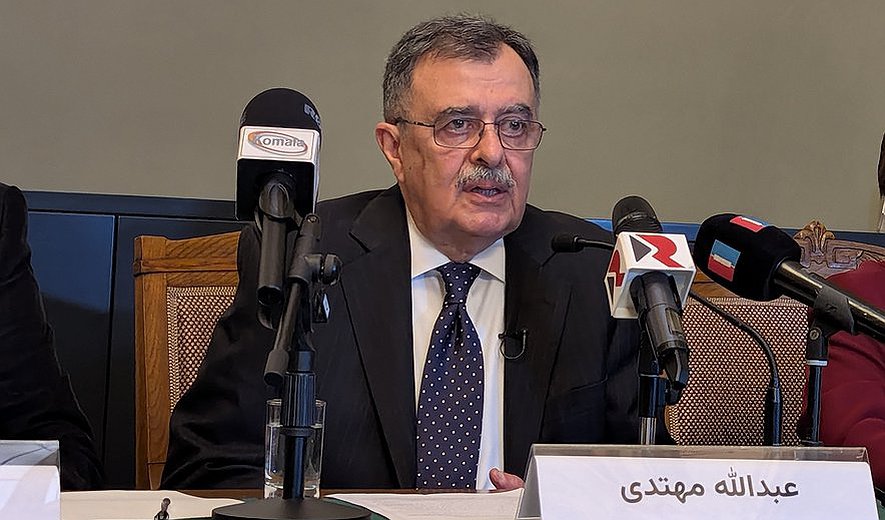
Abdullah Mohtadi, Secretary-General of the Komala Party of Iranian Kurdistan, told participants at the opening panel of the conference “Human Rights in Post–Islamic Republic Iran” in Oslo that the experience of the Islamic Republic has proven there can be no sustainable future for Iran without democracy, pluralism and justice during the transition period.
The two-day conference, held on 18–19 October 2025 and organised by Iran Human Rights (IHRNGO), brought together a wide spectrum of political groups and civil society actors. Mohtadi thanked the organisers for creating a space where divergent political voices could engage in dialogue, stressing that transitional justice must be guided by contemporary international standards and grounded in a rejection of revenge killings or arbitrary executions.
“If Iran’s future is to learn anything from the painful experience of the Islamic Republic,” Mohtadi said, “it must envision a democratic and pluralistic country—one that recognises human rights in all their ethnic, linguistic, cultural, religious, political and gendered dimensions.”
Mohtadi outlined what he described as three central crises defining Iran’s present moment: the collapse of political legitimacy, entrenched corruption and systemic dysfunction, and a foreign policy built on regional destabilisation.
“The Islamic Republic has long ceased to govern the country,” he argued. “It merely controls it. The only institutions that still function are its mechanisms of repression.”
He added that the Islamic Republic’s regional strategy—rooted in ideological expansionism and the cultivation of proxy militias—is fundamentally aimed at constructing a ‘Shia empire.’ These policies, he said, have been primary drivers of sanctions, economic collapse and Iran’s deepening international isolation.
Mohtadi warned that Iran is now on the threshold of major change, noting that no signs indicate a meaningful shift in the regime’s core policies.
“The gap between the people and the state grows wider every day,” he said. “This trajectory leads either to a mass popular uprising, to internal rupture within the ruling elite, or to a combination of both.”
Turning to the opposition, Mohtadi questioned whether democratic opponents of the Islamic Republic—both inside and outside the country—have achieved the unity required at such a critical juncture.
He highlighted that although many opposition forces formally endorse the broad principles of a democratic Iran after the Islamic Republic, they have yet to form the large-scale coalitions typically seen in decisive political moments.
“If such cohesion exists,” he asked, “where are the broad alliances? The project-based partnerships that, even if temporary, can act with clarity and purpose during turning points like this?”
Mohtadi expressed hope that the Oslo conference could help lay the groundwork for such coordination, arguing that a shared discourse and mutual understanding among opposition groups would be essential for navigating the political transitions ahead.
Translated from Farsi via machine translation and lightly edited for clarity.
More from @ihrights
IHRNGO is building a strong civil society, through empowerment of the citizens, promoting and defending the human rights.
Latest Cartoon
Latest Report