Mahdieh Golroo: A New Political Architecture Is Essential to End Authoritarianism
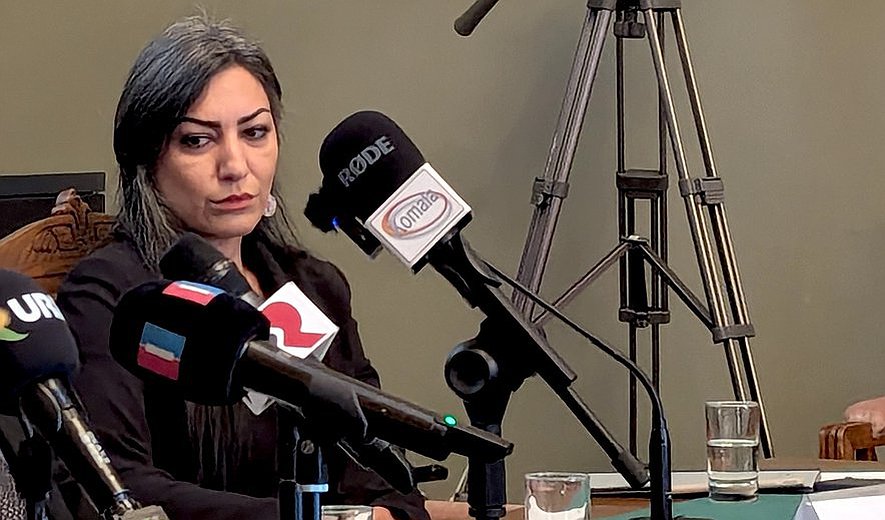
Mahdieh Golroo, member of the executive political board of the Solidarity of Iranian Republicans, said that preventing the return of authoritarian rule requires designing a new political architecture in which law and power serve the people.
Mahdieh Golroo, member of the executive political board of the Solidarity of Iranian Republicans, said that preventing the return of authoritarian rule requires designing a new political architecture in which law and power serve the people.
According to Iran Human Rights (IHRNGO), Golroo made the remarks at the conference “Human Rights in Post–Islamic Republic Iran,” held in Oslo on 18–19 October 2025. At the beginning of her speech, she described the Islamic Republic as an authoritarian and discriminatory system that has violated human rights in multiple areas, including gender, ethnicity and religion.
“All of Iran’s economic, environmental and political crises have their roots in human rights violations,” Golroo said, “and the modern understanding of human rights is no longer limited to individual freedoms but also includes the right to education, healthcare, a healthy environment and social justice.”
Introducing the organisation she represents, Golroo said that the Solidarity of Iranian Republicans seeks a transition from the Islamic Republic and the establishment of a democratic and secular system based on social justice and equal rights.
Golroo stressed the decisive role of a future constitution in safeguarding democracy. “A new political architecture must guarantee that the cycle of authoritarianism will not be repeated,” Golroo said, “and the constitution must ensure a genuine separation of powers and decentralisation of authority.” She also emphasised the importance of strong local councils and the removal of ideological and unelected institutions from the foundations of a future political system.
She described transitional justice as a key mechanism for preventing the re-emergence of authoritarianism. “The principle of non-recurrence must be central to transitional justice,” Golroo said, “because forgetting past crimes creates the conditions for authoritarianism to return.” She referred to the experience following the collapse of the Soviet Union as an example of how unresolved injustices can affect political transitions.
Golroo also emphasised the need to reform security and judicial institutions. Organisations such as the Islamic Revolutionary Guard Corps (IRGC), which were established to enforce repression, cannot have a place in a future democratic system, she said.
Referring to widespread discrimination in the education system and the patronage-based structure of Iran’s administrative institutions, Golroo said rebuilding universities and public institutions after the transition would be essential so that qualified and independent professionals can replace politically selected individuals.
In conclusion, she stressed that sustainable democracy depends not only on outcomes but also on the path taken to achieve it. “Sustainable democracy does not emerge merely from the outcome of change,” Golroo added, “but from the path through which that change is achieved and from strengthening civil society, free media and independent organisations.”
Translated from Farsi via machine translation and lightly edited for clarity.
More from @ihrights
IHRNGO is building a strong civil society, through empowerment of the citizens, promoting and defending the human rights.
Latest Cartoon
Latest Report