Esmail Abdi: Education Is Being Held Hostage by the Islamic Republic
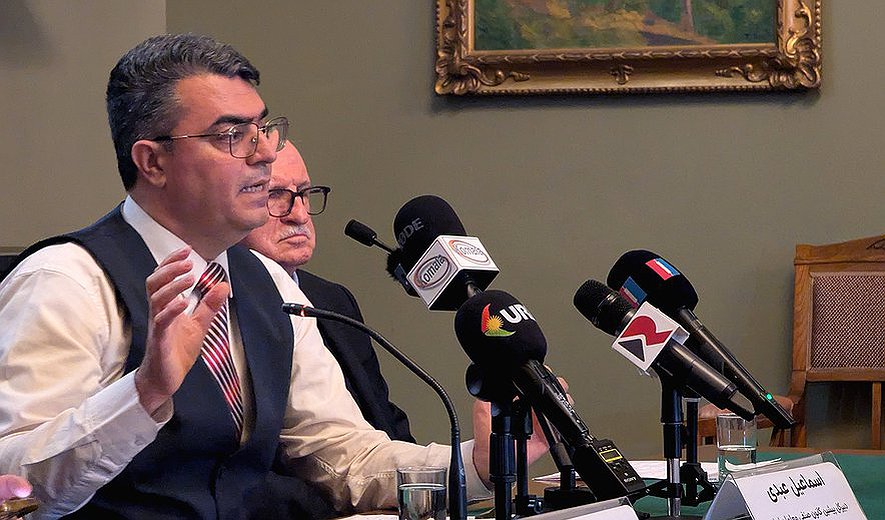
Esmail Abdi, former Secretary-General of the Iranian Teachers’ Trade Association, said that education has been turned into an instrument for producing a compliant generation under the Islamic Republic.
Esmail Abdi, former Secretary-General of the Iranian Teachers’ Trade Association, said that education has been turned into an instrument for producing a compliant generation under the Islamic Republic.
According to Iran Human Rights (IHRNGO), Abdi made the remarks at the conference “Human Rights in Post–Islamic Republic Iran,” held in Oslo on 18–19 October 2025. He welcomed the creation of a space in which “representatives of different social currents can engage in dialogue together,” describing it as essential for Iran’s democratic future.
“The Islamic Republic has turned education into a tool for producing an obedient generation,” he said, “and as long as educational justice and the right to organise are not guaranteed, speaking about democracy is meaningless.”
Referring to the past four decades, he said that from the very beginning of its rule the Islamic Republic transformed the education system into a mechanism for shaping an ideologically compliant generation. He recalled that following the Cultural Revolution, “teachers affiliated with political movements were purged, Bahá’ís were removed from the education system, ideological opponents were demoted, and some were even executed.” According to him, these events form a documented part of the history of education in Iran.
Abdi then referred to the formation of the Iranian Teachers’ Trade Association and the establishment of the Coordinating Council of Teachers’ Trade Associations. “The forty-day protest in front of parliament in 2006 showed that when teachers act in an organised manner, they become a decisive force,” he said. He added that it was precisely this collective power that led to widespread repression by the authorities, although professional networks among teachers were revived again during the 2010s and later played a significant role in the Woman, Life, Freedom movement.
According to Abdi, teachers and students were among those on the front lines of the protests, and a number of young conscripts were also detained for participating in demonstrations. He then described the scale of discrimination in the education system. “We face a shortage of 300,000 teachers, classrooms are overcrowded, standard education has become a luxury commodity, four million children are out of school, and in Balochistan the dropout rate is seven times the global average,” he said. He added that the country’s educational infrastructure still falls significantly below international standards.
He also referred to a new wave of repression against teachers following the Woman, Life, Freedom movement. “More than 300 teachers have been dismissed,” he said, “fourteen in Kurdistan and eight in Kerman have received sentences, and in Khuzestan the entire board of a teachers’ association has been convicted.” He emphasised that informal networks and grassroots support funds created by teachers themselves represent some of the most important pillars of civil society and must be taken seriously by political parties.
Addressing the question of political freedoms during a transition period, he referred to Articles 19 and 21 of the Universal Declaration of Human Rights. “Media outlets must not be restricted,” he said, “because eliminating one’s rivals means reproducing the logic of the Islamic Republic.” He pointed to dialogue sessions held in prison—between activists from Azerbaijan, workers from Haft Tappeh and members of the Iranian Writers’ Association—as examples of how such discussions can help remove misunderstandings.
In his concluding remarks, Abdi referred to meetings with teenagers who had been injured during protests and said that schools and universities have long been centres of resistance to authoritarian rule. The younger generation, he argued, has developed its own language and political expression, and political parties must understand the psychology of this generation. “The future of democracy in Iran will pass through these young people,” he said.
Translated from Farsi via machine translation and lightly edited for clarity.
More from @ihrights
IHRNGO is building a strong civil society, through empowerment of the citizens, promoting and defending the human rights.
Latest Cartoon
Latest Report